SEO Activities That Still Matter in the AI Search Era

As someone who works closely with small business owners and marketers navigating the ever-changing search landscape, I’ve seen firsthand how AI is shifting the game—especially with the recent launch of AI mode in India, which is revolutionizing local search experiences.

The shift is real — yes. But the fundamentals? They haven’t gone anywhere.

Recently, I shared a LinkedIn post about something many of us in SEO feel deeply: “Yes, AI is changing how people search, but amidst all the noise, some SEO foundations remain unchanged.” 

And the response? Remarkable.

One marketer said: “ User Intent is becoming crucial” Another founder told me: “SEO basics still do the heavy lifting—clarity, value, and trust always matter.” These perspectives weren’t outliers—they reflect what many of us are observing daily.

So, in this blog, let me walk you through 12 SEO activities that still matter — even after search being more intelligent.

Why AI Is Dominating the Search Landscape

Organic search drives over 53% of website traffic across industries. And as AI has become an important part of how Google processes, ranks, and presents information:

  • AI Overviews shortens answers from trusted sources in SERPs.
  • SGE pulls info from structured data, FAQs, and topically relevant content chunks.
  • Entity-based search understands context, not just keywords.

But here’s the catch: AI doesn’t replace SEO—it makes good SEO even more essential. 

How SEO Is Evolving in 2025

SEO in 2025 is no longer just about optimizing for keywords—it’s about optimizing for understanding. With the rise of AI-powered search engines like Google’s SGE and tools like Perplexity, SEO has shifted toward contextual relevance, chunk-level content delivery, and real-time intent matching.

SEO now prioritizes:

  • Answer-first content that directly addresses user queries
  • Semantic-rich structure, using headings, schema, and internal links to guide AI comprehension
  • E-EAT signals (Experience, Expertise, Authoritativeness, and Trust)
  • User experience metrics, like scroll depth, engagement, and mobile responsiveness

In short, SEO has become more intent-driven, structured, and AI-aligned—but its core purpose remains: helping search engines discover, understand, and recommend the best content for users.

Still after all these transformations, SEO remains the same: it helps search engines understand, rank, and show the best content to the users.

And that’s where these next 12 activities come in…

Let’s chat →

Evergreen SEO vs AI- Driven SEO (which SEO activities should be prioritized for long- term success)

Even in the face of such AI disruption, some SEO strategies continue to drive rankings, clicks, and conversions because they align the way that AI is reading, summarizing, and ranking web content.

Let’s take a look at them.

 1. FAQ Sections (AI Answer-Box Friendly)

A FAQ page is a structured page that answers frequent inquiries from clients regarding your product, service, or subject.

It improves the user experience and can be marked up using Schema.org structured data to support rich results.

Why is it Important:

FAQ content feeds directly into AI models and Google’s featured snippets. 

These sections help break content into easy-to-digest answers, which AI search engines like Google SGE can extract for contextual responses. They also improve time on page and reduce bounce rate—factors AI models consider for helpfulness.

Use Case:

  • Answering service-specific queries like “Is Local SEO worth it in 2025?”
  • Enhancing your Google Business Profile page with Q&A
  • Optimizing eCommerce product pages with buying-related questions
  • Appearing in voice search queries (e.g., “Hey Google, does SEO still work?”)
  • Supporting Google’s People Also Ask and AI snippets

Pro Tip:
Use schema markup (FAQ Page) to annotate these to AI and enhance featured snippet eligibility. 

Image Explaining FAQ Section

2. Meta Titles & Descriptions

Meta description and titles are HTML tags that control how your page is shown on SERPs. They aren’t a ranking factor in themselves, but still they do impact CTR and relevance signals that AI search models consider.

Illustrative showing Meta Title & Meta Description of DigicobWeb

Why is it Important:

In spite of the invention of AI search, click behavior and semantic relevance are still applicable. Google constantly rewrites titles/descriptions, but well-written meta tags still affect the way the user sees your content.

It helps AI summarizers provide accurate previews in SERP overlays.

Use Case:

  • Improving visibility for local landing pages (e.g., “SEO Company in Ahmedabad | DigiCobweb”)
  • Targeting long-tail keywords in high-converting titles
  • Reducing bounce by writing expectation-matching descriptions
  • Increasing CTR in AI Overviews and Top Stories
  • Supporting Open Graph previews for social sharing

3. Heading Structure (H1 to H3 for Chunking)
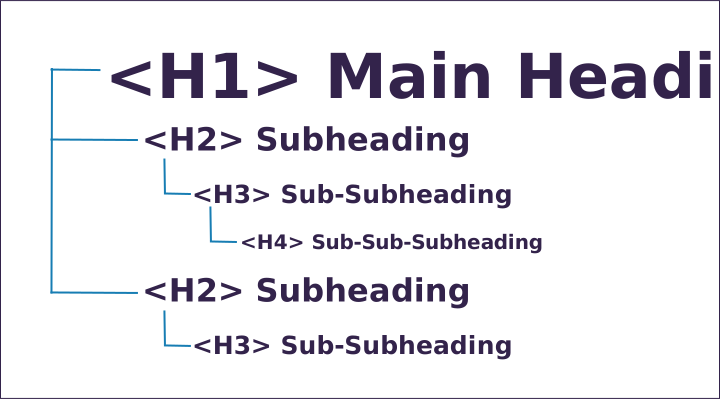
Image explaining Proper Heading Structure  (H1> H2 > H3> H4)

Why is it Important:

A clean heading structure makes your content more chunkable, digestible, and feature-snippet eligible. It’s essential for accessibility, too.

Use Case:

  • Structuring local service pages with “H1: Local SEO Services,” “H2: Why Local SEO Works”
  • Creating scannable blog formats optimized for AI overviews
  • Enabling FAQ-style answers under H2s
  • Improving accessibility and voice-reader compatibility
  • Supporting TOC generation in AI-powered search previews

Tip: Instead of writing paragraphs under one heading, break down processes (like “How to Set Up GBP”) into H2 and H3 steps.

4. Semantic SEO (Synonyms & Related Terms)

Semantic SEO is the process of optimizing content by concentrating on primary keywords, employing synonyms and synonymous ideas, and matching the content with what individuals are actually looking for. 

It emphasizes understanding and addressing the intent behind search queries to improve search engine rankings naturally.

Why is it Important:

AI search is keyword-non-dependent and is based on Natural Language Processing (NLP). Semantic SEO gives content semantic richness and aligns with the way AI processes queries. It makes content more visible in AI-created snippets and voice responses.

Use Case: 

  • Using terms like “AI-proof SEO” alongside “evergreen SEO tactics” in cluster content
  • Covering related terms like “Google Maps Ranking” when discussing Local SEO
  • Writing content with natural keyword variations for AI answer boxes
  • Boosting E-E-A-T signals by covering topic comprehensiveness

Tools Tip: Tools like Clearscope or SurferSEO helps to discover semantically related keywords.

5. Topical Authority and Internal Linking

Topical authority is perceived expertise on a particular subject on your site gained by having thorough content that discusses all aspects of a topic. Internal linking ties related content items (such as blog posts, service pages, and resources) together through contextual anchor text, which allows users and search engines to see how they are related to each other.

Why is it Important:

Building on-topic authority with ‘content clusters’ whereby a lead pillar page points to several supporting cluster pages shows expertise and relevance. Internal links guide crawlers, distribute page authority, facilitate user navigation, and help AI models recover semantically related chunks of information more effectively.

When AI systems (like Google’s SGE or Perplexity) break down queries into sub-intents, they look for content that answers each dimension. Sites with strong topical clusters are more likely to have their content surfaced and synthesized into multi-source answers.

LinkedIn comment from Hiren Dave highlighting the lasting value of topical depth and internal linking in SEO content clusters for stronger AI search performance.

💬 Hiren Dave, added: “Focusing on topical depth and internal linking within a content cluster continues to pay off.”

And he’s absolutely right. Topic depth signals to search systems that you’re more than just another blog—you’re a knowledge source.

Use Cases:

  • Link from pillar content on “Local SEO” to in-depth blog posts on Google Business Profile, NAP consistency, and citation building.
  • Interlink all franchise SEO service pages with one another to establish semantic relevance.
  • Use anchor text like “technical SEO audit checklist” to link to similar guides and make content more discoverable.
  • Improve the site structure so that there is no single page that is isolated (i.e., has a minimum of one internal link).
  • Strengthen contextual relations among AI-pertinent clusters, i.e., among schema markup blog posts and voice search blog posts and FAQs.

6. Content Clustering 

Content clustering is an internal linking strategy where a central “pillar” page targets a broad topic and links to “cluster” pages covering subtopics. This builds topical authority and relevance.

Why is it Important:

 In the AI era, topical depth matters more than keyword repetition. Clustering signals to Google and AI engines that your site comprehensively covers a subject. It also enhances navigation, internal linking, and time-on-site.

Use Case:

  • Building a Local SEO pillar with cluster blogs like Google Business Profile Optimization, Citations Strategy, etc.
  • Supporting multi-location businesses with city-wise subpages
  • Creating AI-friendly content silos (e.g., SEO for Law Firms → Technical SEO, Content SEO, GBP SEO)
  • Boosting link equity to key service pages
  • Enhancing site architecture for crawlability and topic mapping

7. Clean URL Structure

Clean URL Structure is brief, to the point, and has appropriate keywords without any extra parameters, underscores, or dynamic IDs.

For example:  www.digicobweb.com/local-seo-services than, www.digicobweb.com/page?id=123.

Image explaining Clean URL Structures

Why is it Important:

A Clean URL assists both search engines and visitors to easily comprehend the organization of your site quickly. It builds higher trust and CTR from organic and AI-driven results.

Use Case:

  • Creating geo-specific pages like /services/local-seo-ahmedabad
  • Improving click-through from Google’s AI Overviews or search features
  • Enhancing keyword relevance of landing pages and clusters
  • Supporting better internal linking for topic clusters
  • Making URLs easier to share and remember across devices

8. Schema Markup /Structured Data 

Schema markup is embedded information you place on your site code that tells search engines what your content is. It enhances your listings with rich results like FAQs, star rating, local business information, etc.

Why is it Important:

In the AI search era, schema helps machines not just crawl but also “comprehend” your content. Structured data increases your chances of being featured in AI-generated abstracts, voice search, and rich SERP features. It’s the foundation of Entity SEO and feeds Google’s AI understanding of your brand and services. Leads from SEO close at 14.6% compared to just 1.7% for outbound leads.

Use Case:

  • Adding LocalBusiness schema to support Google Business Profile relevance
  • Marking FAQs, reviews, and products for enhanced AI and rich result visibility
  • Using BreadcrumbList to improve content hierarchy recognition
  • Supporting event schema to appear in local event results
  • Integrating HowTo schema for tutorials and guides

Tools Tip: Try Google’s Markup Helper or RankMath plugin.

9. Robots.txt & Sitemap.xml

Robot.txt: Robots.txt may be a content record that tells look motor creepy crawlies which pages or segments of your site to crawl or not to crawl.

Sitemap.xml: Sitemap.xml could be a well-structured list of pages on your location that makes a difference when motors find and record your substance in a compelling way.

Image showing example to how to write Robot.txt and sitemaps


Why are they Important: 

AI search models are highly reliant on indexed, crawlable, and contextually mapped content. If main pages are not crawling nor indexed in your sitemap, they would not appear in standard or AI search results. These files form the foundation of how bots understand your site.

Use Case:

  • Blocking crawl of admin pages, duplicate URLs, or staging sites
  • Ensuring newly launched location pages are quickly indexed
  • Improving crawl budget for large multi-location websites
  • Helping AI engines discover structured and siloed content
  • Preventing outdated or thin content from being surfaced in AI previews

10. Page Speed Optimization (Core Web Vitals)

Page Speed Optimization is the act of improving the rate at which your pages load—especially on mobile—by improving metrics like Largest Contentful Paint (LCP), First Input Delay (FID), and Cumulative Layout Shift (CLS) based on Google’s Core Web Vitals.

Why is it Important:

Page speed directly impacts user experience, conversion, and AI performance metrics. AI algorithms maximize for quickly loading, mobile-friendly content to deliver better results. A slow site can reduce your visibility in both traditional rankings and AI summaries.


Checking Page Speed of an Website

Use Case:

  • Compressing images for GBP-optimized service pages
  • Deferring non-critical JavaScript and using lazy-loading
  • Fixing CLS issues on mobile for improved readability
  • Boosting speed on multi-location landing pages to increase engagement

Tools Tip:
Use PageSpeed Insights or GTmetrix to inspect.

11. Writing Answers, Not Just Keywords

Writing Answers refers to optimizing your content by addressing actual user questions instead of stuffing exact-match keywords. It’s about conversational, helpful, and answer-first writing.

Why is it Important?

AI search tools such as SGE and ChatGPT reward useful answers.. Content that answers the user’s question directly — particularly in natural language — will be more likely to be cited or summarized. It also helps boost your chances of being featured in “People Also Ask” and voice search.

LinkedIn comment by Vishvam Mangroliya emphasizing the power of structure, clarity, and context in SEO today—moving the focus from keyword targeting to resolving search intent.

💬 Vishvam Mangroliya, commented: Structure, clarity, and context have become the real ranking signals. We’re shifting from keyword targeting to query satisfaction. AI models don’t care if your content is answering the purpose of the search.

His insight perfectly captures the shift—your SEO should focus on solutions, not just syntax.

Use Cases:

  • Use the format of H2s as questions users ask on Google or Quora
  • Write in a natural voice that reflects conversation
  • Answer concisely at the beginning of each section, then elaborate
  • Monitor search intent via tools like AlsoAsked, AnswerThePublic
  • Update existing blog intros with direct question-based framing

12. Mobile App Optimization (Responsive Design)

Mobile optimization helps your site to operate and display properly across various screen sizes and devices.

Why is it Important:

AI engines are biased towards mobile-first content. If your website is not mobile-friendly, it will never be suggested by Google’s AI-based features, nor will it be displayed prominently in local search.

Use Case:

  • Creating fully responsive layouts for local service pages
  • Making tap-to-call and click-for-directions buttons functional on GBP
  • Optimizing CTAs and content blocks for mobile scroll behavior
  • Using mobile-friendly fonts and touch zones for better UX
  • Running mobile usability tests via Google Search Console

Conclusion: AI Is Evolving, But SEO Rules Are Also the Same

Let me leave you with this: SEO is not a tech to-do list—it’s a long-term process of earning trust. And even in the age of AI, it’s most important how useful, well-structured, and relevant your content is.

These 12 activities we just explored… They’re not tricks—they’re principles. They ensure your business shows up when and where it matters, whether it’s a traditional search result or an AI-generated overview.So no, SEO isn’t going anywhere. It’s simply becoming smarter—and so should we.
Content Marketing Ideas to Grow Your eCommerce Traffic

People are no longer waiting in lines or rushing to crowded stores because online shopping now feels normal to most. As reported by Statista, eCommerce sales worldwide could reach about 6 trillion dollars in 2024. That kind of number shows how much competition is out there.
Bar graph showing global e-commerce sales growth from 2022 to 2028

(Image Source)

Even with great products, an online store will not get far if no one sees it. Around 53 percent of traffic still comes from unpaid search, which means helpful content matters more than ever. It builds trust and keeps people coming back.
Visual diagram of the digital marketing strategy cycle showing key stages

SEO Optimization

Good content only works if people can find it, so SEO should be your starting point. Search engines still account for a large share of online traffic, and publishing relevant, keyword-targeted content is one of the most reliable ways to improve your visibility over time.

  1. Do Proper Keyword Research

The first step is finding the right words that your potential buyers search for. Start by exploring the words your customers might search for when looking for your products or browsing your niche. This helps shape your blog topics, product page copy, and FAQ sections into valuable SEO content for e-commerce.

  1. On-Page Optimization

After choosing the right keywords, use them naturally in your titles, headings, image descriptions, and meta details. Keep the writing simple so visitors can understand it without any effort. Pages with logical headers and useful internal links perform better and help search engines understand your site.

  1. Link building

Creating helpful blog posts and product guides can attract natural backlinks over time. You submit guest content to relevant blogs. These links can bring in fresh visitors and help search engines see your site as more trustworthy.

Social Media Marketing

When you post on social media, you are not just promoting. You are starting a conversation. Platforms like Instagram and YouTube help people get to know your brand, even if they did not plan to find you.

  1. Focus on Targeted Ads

Rather than spending on broad campaigns, try setting up simple ads that speak to specific interests. Show a product to someone who viewed a similar item last week or display a promotion to users in a particular location. This smart targeting helps drive traffic to your online store without wasting your budget on the wrong audience.

  1. Promote with Influencer Marketing

You do not always need a celebrity. In many cases, smaller creators with steady followers can make a bigger impact. Choose partners whose style and voice align with your brand values, then give them the space to share your product in a way that feels natural.

  1. Try to Engage Customers on Social Media

When someone comments or reacts, take a moment to reply. Ask simple questions or thank them. It makes the interaction feel real, not automated. The more real your brand feels, the more likely people will return. Social media plays a big role in many e-commerce marketing ideas, and even small efforts here often lead to bigger results later.

Use Blog Posts to Offer Real Value

A blog is more than a marketing tool. It is a place where your brand can be helpful, honest, and informative. A well-written article can answer a buyer’s question before they even ask it. That is why blogging is such a key part of content marketing for e-commerce.

  1. Answer Common Customer Questions with Guides

Think about what people usually ask before buying. Whether it is sizing, materials, care instructions, or comparisons, writing guides that answer these questions builds trust and reduces doubts.

  1. Write Comparisons to Help Buyers Choose

Customers often want help choosing between products. Show them what makes each one different. Talk about price, features, or when to use it. Keep it clear and honest. These posts often get shared and bookmarked, helping increase eCommerce traffic.

  1. Share How Your Brand Solves Problems

Talk about the real issues your products solve. Share relatable examples or customer challenges. Sharing real stories helps people relate to your brand and remember your products for the right reasons.

Create Videos That Connect With People

Video is not just entertainment. It is an essential part of content creation for e-commerce. A short, helpful video can sometimes deliver over a thousand words of text.

  1. Show Your Products in Everyday Use

People want to see how your products fit into real life. Show someone wearing, using, or unboxing the product in a natural setting. This improves clarity and reduces returns while also increasing buyer confidence.

  1. Explain How Things Work in Simple Steps

Short how-to videos or setup guides help users get started. These can live on your site or be shared across social platforms, building more trust with your audience.

  1. Let Happy Customers Tell Their Stories

Video testimonials create powerful social proof. Real voices and faces help new visitors feel reassured. These also fit well with your broader e-commerce content marketing strategy.

Improve Visibility With Search-Friendly Content

Not every visitor is ready to buy today. Some are researching, comparing, or simply browsing. Publishing search-friendly content helps capture these early-stage customers and introduce them to your brand.

  1. Use Words That People Search for Online

Be intentional with your language. Use the terms people naturally type into search engines. It helps your blog stay useful and makes it easier for people to find you through search. This approach strengthens content ideas for e-commerce and improves content visibility over time.

  1. Write Clear Product Descriptions With Purpose

Your product descriptions should not just fill space. They should answer questions, highlight benefits, and use keywords carefully. This type of detail supports SEO content for e-commerce and encourages conversions.

  1. Keep Evergreen Articles Fresh and Updated

The evergreen posts, like buying guides, seasonal trends, or tutorials, should always be refreshed regularly. Update dates, links, and images to show readers the content is current.

Let Customers Contribute Content (UGC)

Your buyers are often your best marketers. When they create content about your brand, it adds authenticity and encourages others to trust your products.

  1. Invite Reviews That Share Honest Feedback

Ask your customers to share honest reviews and include pictures or short videos when possible. Make it easy to submit feedback by sending a post-purchase email. These testimonials help build credibility and often rank well in search.

  1. Start Photo Challenges That Feature Your Products

Create small challenges or contests around your product—like “how you style it” or “before and after” posts. It gets people involved and helps more potential customers discover your brand.

  1. Display Customer Posts Across Your Channels

Share the best content your customers create on your homepage, product pages, and social profiles. It supports your brand message and gives your store a more personal feel.

Add Interactive Content to Your Strategy

Interactive experiences keep users engaged longer. They are a fun way to learn about your customers and guide them to the right product.

  1. Create Simple Quizzes That Match People With Products

Simple quizzes such as “What suits you best?” can make shopping feel more personal. They also help you learn what your customers are looking for.

  1. Use Small Polls to Learn What Customers Prefer

Running short polls on social media or your website helps you understand preferences. It shows that you value their opinions, increasing brand loyalty and engagement.

  1. Offer Handy Tools That Solve a Tiny Problem

Create micro-tools like size charts or shipping calculators. These small additions support content marketing for e-commerce by adding value to your site.

Conclusion

Each time you publish content, you give your brand a real voice. When that content solves problems or answers questions, people notice and often come back. Many stores chase what is new, but steady growth usually comes from content that stays useful over time. 

If your brand becomes known for being helpful, people begin to trust what you offer. Even a short article or quick video can leave a strong impression. Your goal is not to go viral but to stay present where your audience is looking. That kind of presence builds trust that does not fade easily. A consistent e-commerce content strategy helps you stay relevant without chasing trends.

How to Rank a Local Business: SEO Tactics That Work

What is Local SEO?

Local SEO (Search Engine Optimization) is a way of optimizing an enterprise’s on-line presence so that it gets visibility in nearby seek outcomes. It makes a speciality of growing visibility for place-based searches, like “near me” or precise place based queries. Key elements include Google Business Profile, local keywords, reviews, and NAP consistency.

In this blog, we will break down the latest Local SEO ranking signals, how to optimize your GBP, create high-quality citations, create local content that works, handle online reviews, and monitor your performance in the right way. 

As a small business owner or digital marketer by managing  multiple locations, you’ll be able to create a solid local presence that delivers results.

Factors Affecting Local Search Ranking 

As content nowadays is more intent-driven search behavior affects. Businesses must shape their local SEO strategy according to what actually affects ranking.

The Factors Affecting Local Search ranking are:

  1. Google Business Profile (GBP)
  2. NAP Consistency
  3. Online Reviews
  4. Localised On Page Content
  5. Local Citations and Backlinks
  6. Behavioral Signals
Factors affecting Local Search Rankings
  1. Google Business Profile (GBP): Your Local SEO Anchor

Google Business Profile optimization is one of the strongest signals for local ranking. Ensure your GBP is complete with the correct business category, updated hours, engaging photos, service areas, and regular posts.

Engagement also matters. Listing daily updates and interactions like commenting or posting reviews tends to perform better. GBP is often the first impression for mobile users—make it count.

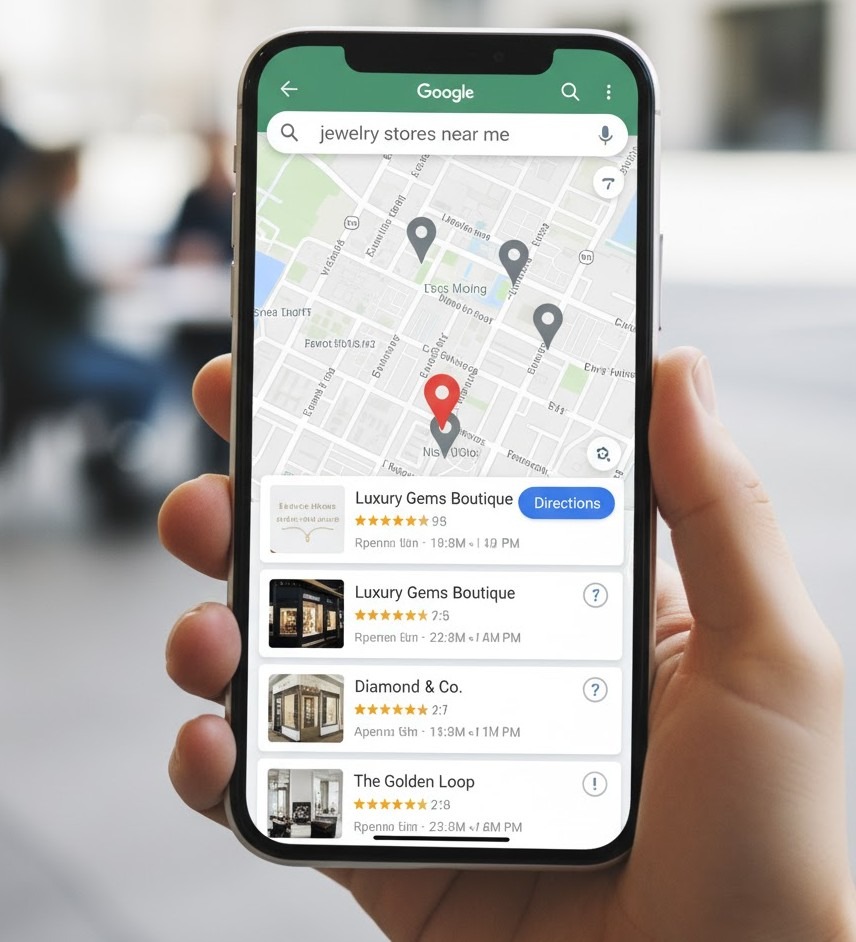
Example of a well-optimized Google Business Profile with local SEO elements
  1. NAP Consistency: Build Trust Across the Web

Google cross-verifies NAP(Name, Address and Phone Number)  records throughout your website, directories, social media, and other listings. Any inconsistency—which includes special formats, old phone numbers, or missing suite numbers—can confuse engines like google and hurt your nearby visibility.

Maintaining a checklist and auditing your website often ensures consistency throughout all platforms.

a. Online Evaluations: Influence Perception And Rating

Critiques are a right away reflection of your commercial enterprise recognition and play an essential role in scores.

Make sure your customers leave feedback and reviews. Also make sure to respond to reviews left by your customers (positive or negative).. Use review keywords naturally; they can help boost relevance for search terms.

  1. Localized On-Page Content: Speak to Your Area

Creating geo-specific service pages, adding location-based keywords, and including details about your local service areas is important. Even your blog content can support local SEO when written around local events, news, or community highlights.

Implementing schema markup and embedding Google Maps can further help search engines understand your geographical relevance.

  1. Local Citations and Backlinks: Establish Local Authority

Citations mention your company’s name and information on sites such as Yelp, JustDial, or local chambers which act as trust indicators. 

Backlinks from nearby and appropriate domains (local news sites or business organizations) acts as an authentication for your business.

Prioritize high quality over volume. Consistency and pertinence are most important.

  1. Behavioral Signals: Engagement That Matters

Google evaluates how users interact with your listings. Metrics like click-through rate, direction requests, and call button taps are strong indicators of relevance. A well-optimized listing that earns more engagement will often climb higher in results.

Google Business Profile Optimization

Google Business Profile Optimization

Google Business Profile (GBP) the single most impactful element of local SEO strategy—and often the first opinion maker for potential customers. If done properly, it can improve your chances of appearing in Google Maps searches.

Steps of Google Business Profile Optimization Checklist

Step #1: Claim And Verify Your Listing

If you haven’t claimed your GBP yet, this is the first step. Visit the official Google Business Profile site and follow the process to claim and verify your business. 

Verification ensures you’re the legitimate owner and you have all features for editing and optimization.

Step #2: Choose Right Business Categories

One of the most overseen yet most important steps is selecting the correct categories. The primary category directly influences what type of searches your business can be shown on,while the secondary categories help in expanding your reach (avoid stuffing irrelevant ones).

Tip: Use Google’s autocomplete feature to explore how competitors are categorized for similar services.

Step #3: Perfect Your Core Business Info (NAP)

Ensure consistency for:

  • Business Name
  • Address
  • Phone Number (NAP)

Step #4: Using High-Quality Photographs & Videos

Upload pictures that show your storefront, group, workspace, and indeed client interactions.Try keeping the photo fashion reliable together with your brand look.

Tip: Videos (under 30 seconds) can too include validity and lock in watchers quicker.

Step #5:Use Posts to Stay Active and Relevant

Use the “Posts” feature to:

  • Promote offers or events
  • Announce changes
  • Share news or milestones

Tip: Include Call To Actions like “Learn more” or “Book now” for driving actions.

Step #6: Respond to Reviews

  • Be polite and respond quickly.
  • Include relevant keywords naturally.
  • Turn negative reviews into trust-building opportunities.

Local Link Building and Citation Strategies

Constructing a strong local search engine optimization presence goes past simply having a Google enterprise Profile. You need to establish authority—and that starts off evolving with citations and links from dependent on nearby sources.

Repeated citation can assist search engines in confirming your business validity and enhancing local ranking.

Build Local Links with Intent

Local backlinks are just as important. Reach out to:

  • Local blogs and news portals relevant to your niche
  • Chambers of commerce or business directories near you
  • Community sponsorships (like school events or NGO partnerships)

These links not only pass SEO value but also reinforce your presence in a specific geography.

Review Management and Reputation

Reviews are important for trust signals for Google as well as your customers. They have a major effect on your local ranking, click-through rates and can help in creating brand perception. 

Why Review Matters?

Google prioritizes businesses with frequent, high-quality reviews. More than just stars, reviews with relevant keywords can boost your visibility for specific search queries.

How to Get Reviews Ethically

Encourage happy customers to leave reviews via:

  • Follow-up emails
  • Short SMS links
  • Print QR codes

The process should be simple and mobile user friendly.

How local businesses use QR codes to collect reviews

How to Handle Negatives Smartly?

Bad reviews must not be ignored, they should be responded to professionally. A considerate response can turn a wrong print into a reputation building moment.

Future Trends in Local Search

Local SEO in 2025 has changed rapidly—and those who adapt quickly will maintain their edge. Here’s what the future has in store for local visibility:

The Future Trends In Local Search
  1. Rise of Voice Search and “Near Me” Evolution

With smart aid becoming the norm, voice inquiries like “best café near me” are surging. This makes mobile optimization, conversational keywords, and local intent targeting more important than ever.

  1. Google’s AI Integration

Google is now using AI to better interpret intent behind local queries—often showing AI-generated overviews, maps, or product listings. Businesses which are strong, have structured data and are consistent with content will be benefited most.

  1. Entity-Based SEO is New Normal

Google increasingly understands businesses as entities, not just websites. This means your brand mentions, reviews, and Knowledge Panel data all contribute to your visibility.

  1. Video and Local Content Integration

Short-form recordings, reels, and localized visual substance are picking up footing in nearby packs and social stages. Sharing behind-the-scenes clips, tributes, or neighborhood occasion scope can increment both engagement and discoverability.

Conclusion: Remain Ahead in Local SEO

Local SEO is not just about showing up on maps anymore—it’s about being trustable, relevant, and visibility in your local area. Whether you’re optimizing your Google Business Profile, creating local links, or handling reviews, all aspects contribute to how Google ranks and how customers decide.As intent, AI-powered results, and hyper-local interaction replace search behavior, therefore companies who will move now will be the ones that rule tomorrow’s local landscape.


Master This Technical SEO Audit Checklist to Improve Online Visibility and Rankings

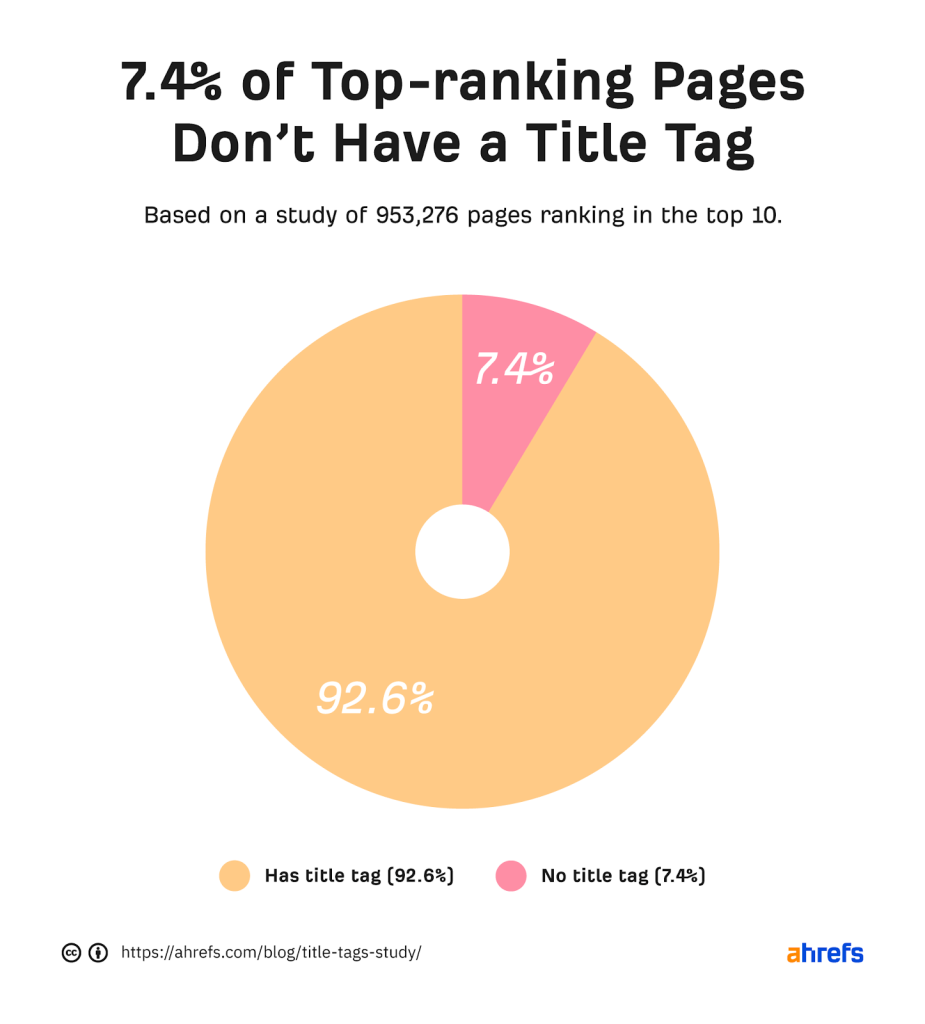
Your website deserves to be on the top of Google SERPs, but is it getting the required traction that it truly deserves? Is technical SEO the primary culprit that is silently holding it back? Even if your website consists of great content and backlinks, it will not be adequate to guarantee visibility, especially when your site is the guilty party in overlooking crawl errors, slow page speed, or poor indexing. Did you know that 7.4% of top-ranking pages on Google do not possess a title tag, which is a badly missed opportunity in the SEO field?

Technical SEO is the invisible factor that can either take your SERP rankings to the top or drag them to the lowest point possible. The ultimate difference between high-performing and underperforming sites is often the different things like XML sitemaps, structured data, canonical tags, and a well-tuned robots.txt file. In this write-up, we will take you through some actionable technical SEO strategies you can execute immediately. This includes the following:

  • A proven audit checklist
  • Speed optimizations
  • Fixes that enhance both search rankings and UX
  • Proper adherence to Google Algorithms for better search results

After reading this blog, the insights you will derive will help you develop a quicker, stronger, and more search-friendly website, irrespective of whether you are developing a site from scratch or refining an existing site. Ready to make the most out of the potential of your website?

The Importance of Technical SEO

When a website does not work well on mobile devices, it does more than frustrate users. It often disappears from the places where most people are searching. It is key in helping search engines reach your pages, make sense of the content, and decide if they should be added to search results. 

Even when your content is well-crafted and your site has solid backlinks, technical issues can prevent it from performing well. A website may work fine, but behind the scenes, it could be stopping search engines from accessing key pages, loading too slowly for users, or showing problems that reduce trust. These issues silently erode user trust and cost your business potential revenue.

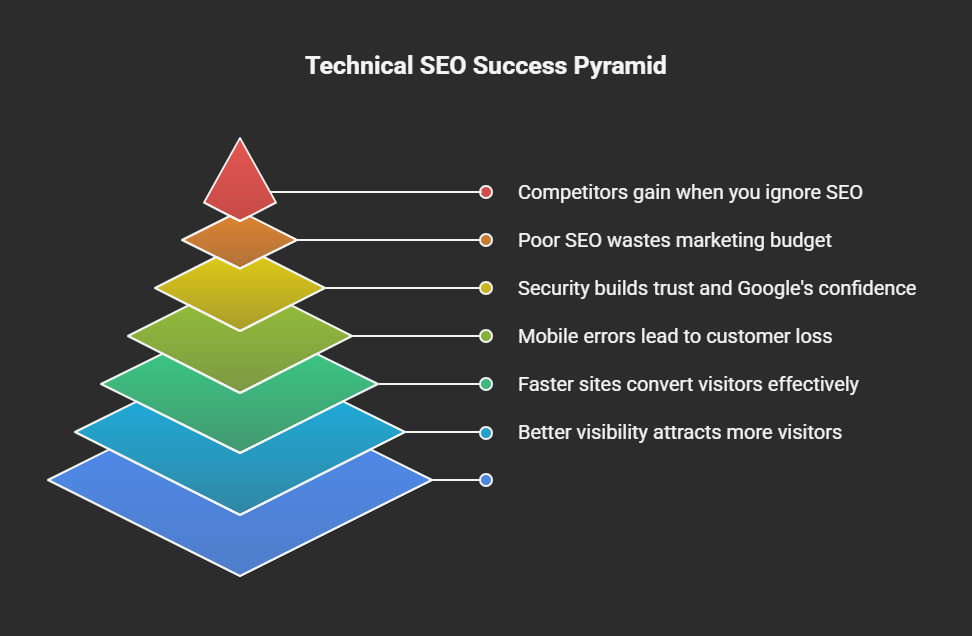
Technical Seo Success Pyramid

Better Visibility

If search engines are blocked from reaching your pages, those pages will never have a chance to rank. That simple fact sits at the core of most technical SEO issues. When your website has broken links, messy redirects, or pages blocked by accident, Google’s bots struggle to crawl your content. 

As a result, some of your most valuable pages might not even appear in search results. This happens silently, without any alert, and you may only notice once the traffic starts slipping. Even high-quality content fails to deliver when search engines cannot index it properly.

Google’s algorithm relies on clean site architecture and structured data to determine where and how your pages should rank. When content is buried under a messy structure or technical mistakes, search engines may skip over those pages or rank them lower.  
Visibility begins with accessibility (and not keywords). That is why technical SEO is not a backend chore. It is the gateway to being discovered in the first place.

Faster Sites Convert More Visitors

Speed is no longer a luxury. Page speed optimization is a core expectation. Most visitors will leave if your site does not load quickly within the first few seconds. This has been shown repeatedly through real-world data from many different industries. 

Fast sites build confidence, encourage action, and create a smooth user experience. Every second matters, especially when buyers are comparing multiple options.

Google has page speed in its ranking algorithm, which makes it a priority. A delay in page load can mean fewer form submissions, lower checkout rates, or missed inquiries. Speed improvements are not just technical upgrades. They are direct enhancements to revenue potential.

Mobile Errors Lose Customers

The world has gone mobile. You are already behind if your website does not perform well on a smartphone. When Google evaluates your website for search placement, it begins by reviewing how the mobile version performs. 

That makes mobile optimization more than a user experience issue. It plays a role in how easily people can find your site, how trustworthy it appears, and how much traffic it receives. 

You lose credibility instantly when mobile elements are broken (buttons too close, fonts too small, images that do not scale). Users do not wait. They move to the next result. Your site will be invisible when it matters the most. Ensuring your mobile experience works flawlessly is a baseline requirement, not an advanced feature.

Security Builds Trust (And Google’s Confidence)

Security is no longer optional. A site that lacks encryption appears untrustworthy, and many users will exit immediately if they see a “Not Secure” notice. That exit means lost traffic, conversions, and a damaged brand reputation.

Adding SSL protection through HTTPS is a simple step that helps visitors feel safe using your website. It also protects customer data and satisfies privacy regulations. Websites that collect payments or personal details must treat security as a top priority. 

Even for informational pages, secure browsing creates peace of mind. A secure site shows Google and your audience that your business takes reliability seriously.

Poor Technical SEO Wastes Marketing Spend

Imagine driving traffic to a page that fails to load, redirects incorrectly, or displays broken content. Every marketing dollar spent bringing people there is wasted. This is where technical SEO becomes a financial decision. If your website has unresolved technical issues, your advertising campaigns, content marketing, and social media promotions suffer lower returns.

Following technical SEO best practices ensures that when visitors arrive, they stay. It removes the friction that causes bounce and improves the flow toward conversion. Without it, the most creative campaign will underperform. Technical readiness makes all other investments more effective, so neglecting it quietly drains your marketing budget.

Competitors Gain When You Ignore It

Your competitors are not always smarter. Sometimes they are simply more prepared. A technically sound website gains traction faster, recovers from setbacks more smoothly, and consistently meets algorithm requirements. That means their site may still rank higher even if your content is better. 

Ignoring the fundamentals gives others an open path to climb above you in rankings. They get more visibility, clicks, and chances to engage your audience. While your team wonders why the numbers are falling, your competitors benefit when they improve their website rankings. 

Staying competitive requires playing the full game and not just publishing content, but building a technically strong foundation to support it.

Long-Term Growth Requires a Strong Foundation

Shortcuts may deliver temporary wins, but search engine algorithms evolve constantly. Sites that rely on hacks or ignore structure often collapse when updates roll out. The websites that stay stable and consistent are those with a solid technical base. 

Canonical tags SEO, updated sitemaps, structured data SEO, and fast-loading pages help them weather changes without panic.

A good foundation supports everything you do online. It simplifies future site updates, ensures compatibility with new tools, and builds trust with users and search engines. Long-term growth is not just about scaling content or adding features.It begins with getting the technical setup right, so every new effort starts from strength, not struggle.

Detailed Technical SEO Audit Checklist

If you are wondering how to improve SEO on website performance, the answer often lies in fixing what search engines cannot see. A detailed audit can reveal hidden problems that limit your website’s performance without drawing much attention. The following checklist covers the core technical areas you must monitor and maintain for strong, lasting search performance.

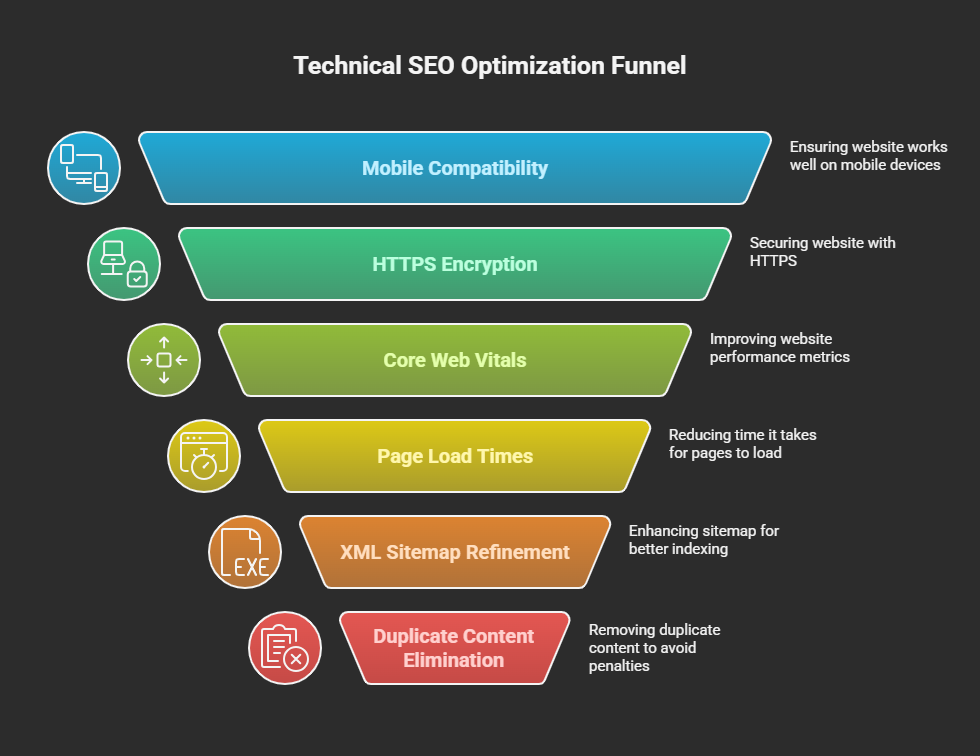
Technical Seo Optimization Funnel

Ensure Mobile Compatibility

A mobile-compatible site is no longer a secondary goal. It is the standard against which every website is measured. A poor mobile experience can mean an immediate loss of engagement. Try opening your website on various screen sizes and devices to check if everything fits well and works as expected. 

Visitors should be able to tap buttons without trouble, read text clearly, and move through the site without confusion. Since Google focuses on how the mobile version of your site performs, a smooth experience on smaller screens is now essential for strong search placement. 

This shift has made mobile usability essential for success, not something you can overlook. A poor experience here will quietly cost you traffic and trust.

Enable HTTPS Encryption

Security is one of the most basic trust signals you can send to search engines and users. A website that uses HTTPS signals that it keeps user information safe and meets current security expectations. 

Installing a valid SSL certificate is now simple and cost-effective, yet many businesses delay this step. Search engines prefer secure sites, and browsers often display warnings when a site lacks encryption. If a user sees a “Not Secure” message, most will leave before engaging. Without it, you risk losing visitors before your content even loads.

Enhance Core Web Vitals

Some websites load quickly but still feel clunky or unstable. Core Web Vitals help uncover those issues by measuring what users experience. They focus on how long the main content takes to show, how fast people can click or scroll, and whether anything on the screen jumps around while loading. 

These are not minor details. Google pays close attention to them when deciding which sites deserve better rankings. A poor experience, even if brief, can lead to fewer clicks and lower trust. Fixing small problems, like shifting banners or slow buttons, can quietly improve your site’s performance.

Speed Up Page Load Times

Speed influences everything. When a site loads slowly, users leave. When it loads quickly, they explore further. Compressing large images, limiting scripts, and enabling browser caching are all simple ways to improve load times. 

Search engines also consider speed when ranking websites, which means performance is tied directly to visibility. Regular testing is necessary because site updates can slowly add weight. Use performance testing tools to identify what is slowing your site and resolve those issues quickly. A faster site delivers better results across every channel.

Refine Your XML Sitemap

Your sitemap should not be filled with broken links or outdated pages that no longer matter. If anything changes on your site, the sitemap must reflect that change. One of the easiest ways to keep track is by checking it through Google Search Console from time to time. Make sure the URLs listed use the correct format and protocol. 

Eliminate Duplicate Content

Duplicate content sends unclear signals to search engines. This dilutes visibility and weakens authority. In cases where similar content must exist, use canonical tags. Remember that duplication can happen unintentionally through filters, categories, or tracking parameters. When you remove duplicate content, your site becomes easier to trust by both users and search engines, as they try to understand it.

Implement Structured Data

Search engines often rely on extra signals to make sense of the content found on a page. That is where structured data comes in. Adding small bits of extra information to your site gives search engines more clarity about what each section means. 

Tools like the Rich Results Test from Google let you check whether the added data works as it should. Clear markup helps search engines show your content in a way that makes sense to those looking for it.

Fix Crawling Issues

When search engines cannot reach parts of your site, those pages often go unnoticed in search results. Look out for blocked pages, server problems, or loops that redirect back and forth. These issues can reduce your visibility. 

Check for crawl errors regularly, especially after making design changes or updates to your site. Fixing these problems makes scanning and understanding your content easier for search engines. A site that can be crawled fully has a better chance of performing well in search.

Optimize Your Robots.txt File

The robots.txt file is often small, but it has a big job. It tells search engines what areas of your website they can explore and which ones to avoid. A misconfigured file can accidentally block important pages or allow access to sensitive data. 

Robots txt optimization ensures it adheres to current best practices and aligns with your objectives. Search engines can crawl key areas like product pages, blog content, and navigation. Block only what is necessary, such as login pages or internal tools. Testing the file helps prevent SEO indexing issues and keeps search engines focused on the crucial aspects.

Streamline Site Structure

The way a website is set up can make a big difference in how quickly people and search engines find what they need. Everything feels easier to explore and understand when the important pages are only a few clicks from the main page. 

Group related content under clear categories and avoid unnecessary nesting. This helps users navigate without confusion and makes it easier for search engines to follow links. Use a clear and consistent URL format, avoid deep folders, and interlink pages where relevant. 

A good structure supports everything else you do in SEO. It enhances crawlability, improves user flow, and gives you a stronger base for scaling your website over time.

Use Breadcrumb Navigation

Breadcrumbs work well on websites with many sections or multiple levels of pages. They let visitors return to earlier points without digging through the main menu. From a search engine’s point of view, breadcrumbs offer a clear internal structure that makes scanning and organizing your content easier. 

They also support extra details in search results, making your listings more useful and noticeable. A site that uses breadcrumbs well often sees better engagement and fewer people leaving after just one page. It is a small feature that quietly improves both navigation and visibility.
You can also check out this on-page SEO template to improve the website performance.

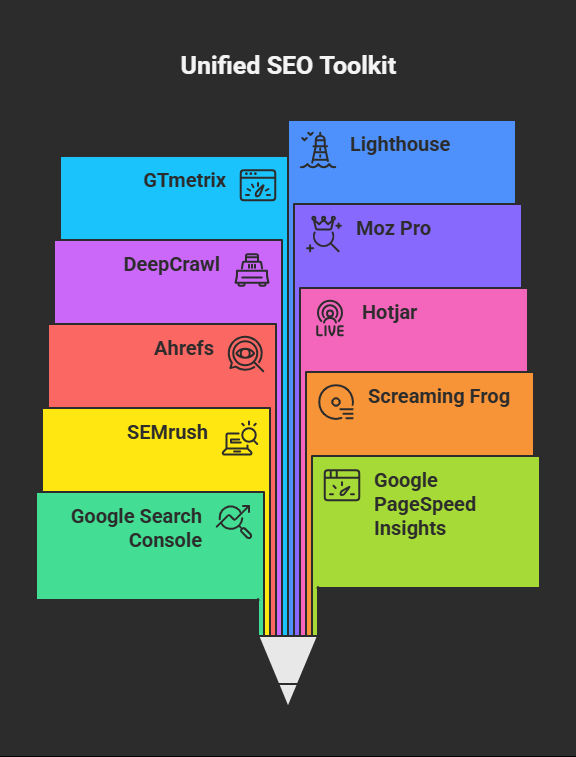
Tools to Automate Your Technical SEO Audit

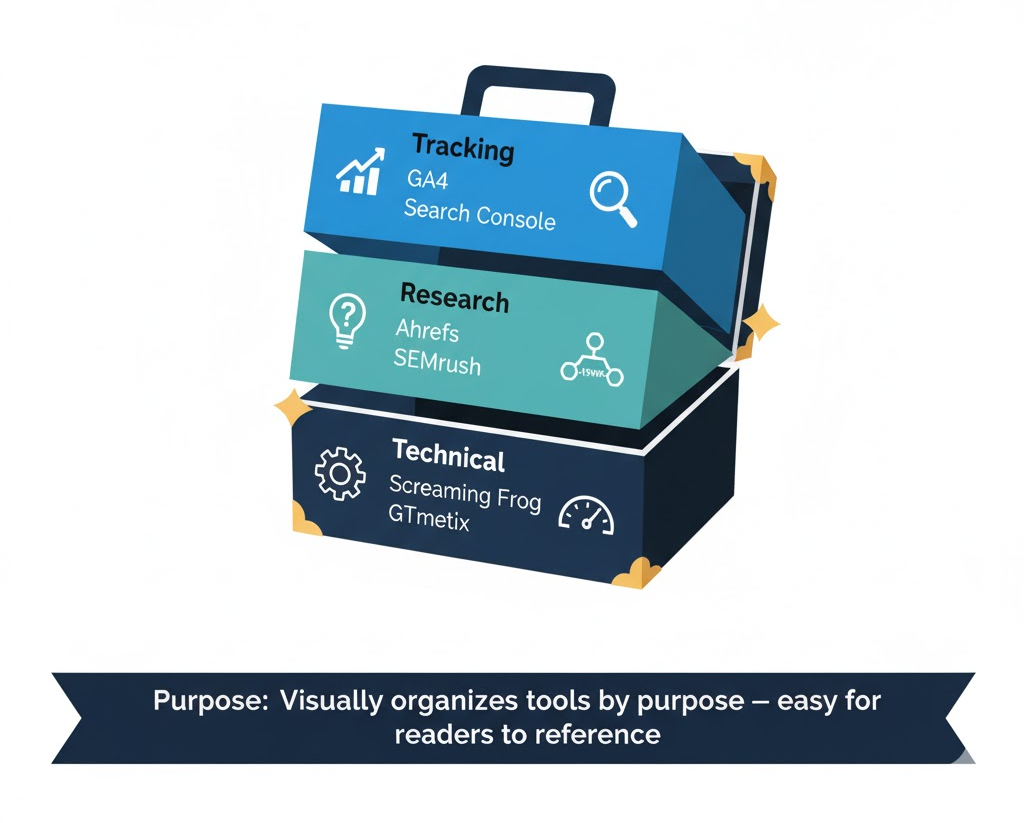
Unified Seo Toolkit

Google Search Console

Google Search Console shows which pages are indexed, whether any crawl issues exist, and how your site performs on mobile devices. You can also track how often your pages appear in search and which queries lead people to your site. The tool alerts when something breaks, helping you fix problems before they grow. 

Search Console also checks structured data, sitemap updates, and manual actions. It offers a reliable view of search visibility for business leaders without needing deep technical knowledge. It is free, accurate, and essential for maintaining long-term performance. Every website owner should connect it and review the data regularly.

Google PageSpeed Insights

Google PageSpeed Insights shows how fast your pages load and how they perform across both mobile and desktop. It gives scores based on important speed indicators and explains what is slowing your site down. You can see if images are too large, scripts are too heavy, or content is shifting while loading. 

The tool also gives clear advice on how to improve these areas. The mobile and desktop results are shown separately so you can focus on what needs work. Improving speed helps keep users engaged, and it would improve website rankings. Regular checks with PageSpeed Insights help you stay ahead before small problems become serious.

SEMrush

SEMrush offers a comprehensive technical site audit feature that scans for hundreds of potential issues. Common issues it can detect are links that no longer work, pages that take too long to load, and sections of the site that are buried too deep to be found easily. 

It provides visual dashboards, making it easier to prioritize what needs fixing. It also tracks historical performance, which helps you measure the impact of improvements over time.

Screaming Frog

Screaming Frog is a downloadable website crawler that maps every link, image, script, and tag on your site. It allows you to explore exactly how search engines view your pages. You can find redirect loops, missing tags, oversized files, and duplicate content in one place. It is ideal for both small and large websites with detailed structural analysis.

Ahrefs

Ahrefs includes a technical audit tool that integrates with its powerful backlink and content analysis features. You can view crawl errors, performance issues, and indexing gaps across your site. It also offers a health score and breakdown of critical and minor issues. Ahrefs makes connecting technical SEO with ranking performance and competitor comparisons easy.

Hotjar

Hotjar is a user behavior tool that complements technical audits by showing how real people interact with your site. Heatmaps and session recordings reveal usability issues that traditional crawlers might miss. For example, users might avoid a button that loads slowly or skip past sections that take too long to appear. 

DeepCrawl

DeepCrawl is a cloud-based platform that runs full-scale audits. It offers automated reports and advanced filtering to analyze site structure, link equity, and indexing status. It integrates with other tools and supports team workflows. If your website has thousands of pages, DeepCrawl clarifies what needs attention.

Moz Pro

Moz Pro includes a site crawl feature that tracks technical SEO issues across your pages. It highlights duplicate content, missing metadata, page errors, and recommendations. The dashboard is easy to understand, making it suitable for SEO professionals and senior teams. It also includes ongoing monitoring so you can stay ahead of new issues.

GTmetrix

GTmetrix specializes in page speed analysis, offering a visual waterfall chart that breaks down load sequence. It shows which resources are causing delays and how each part of the page performs. The detailed and practical insights allow your technical team to make fast changes. 

Lighthouse

Lighthouse reviews how your website performs in key areas. It gives each page a score and includes actionable feedback for fixing weak spots. It is especially helpful for checking Core Web Vitals, structure, and mobile usability. Developers often use Lighthouse, but its data can support broader business decisions.

Get your free analysis report to upgrade your technical SEO.

Monitoring, Strategy, and SEO Governance for Business Impact

Technical SEO does not end once the audit is complete. For sustained success, businesses need systems that monitor performance, align SEO efforts with real business outcomes, and adapt quickly to changes. 

Governance ensures the process is maintained, errors are addressed quickly, and resources are used wisely. Below are nine core areas that help transform SEO from a tactical activity into a reliable source of growth.

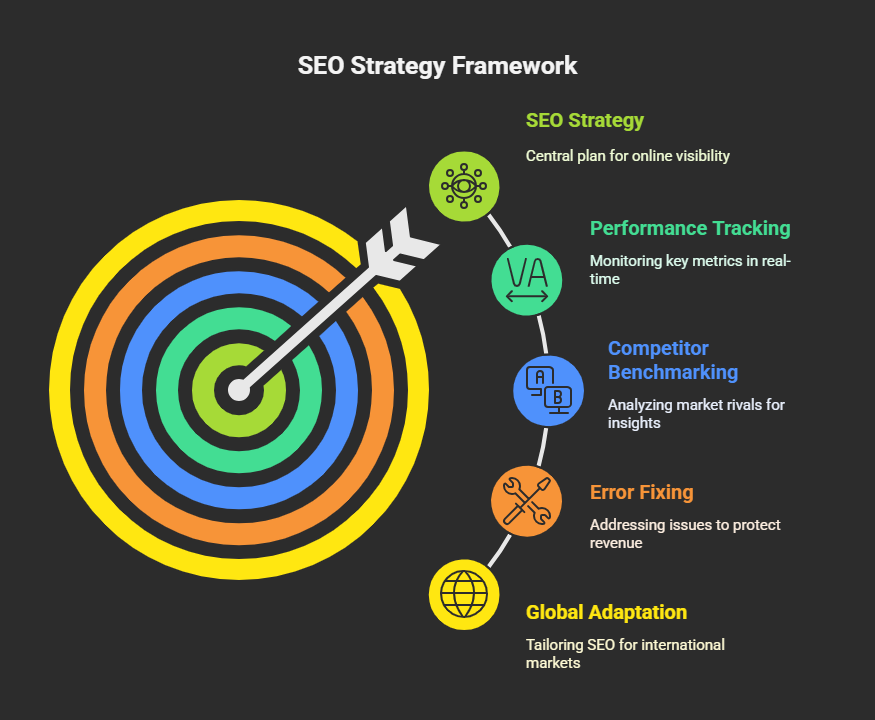
SEO Strategy framework

Real-Time Performance Tracking

Without real-time tracking, your efforts for website performance optimization can fall behind without warning. Keep an eye on important metrics like crawl activity, loading speed, and indexing by using real-time dashboards that track what is happening on your site. Immediate visibility into these indicators helps catch issues early, before they affect users or rankings. 

Tracking data also helps your team measure the effect of updates and content changes. For leadership, this level of insight provides confidence that the site is healthy and performing. It removes guesswork and supports smarter decisions.

Align SEO Strategy with Business Goals

Technical SEO is more than a set of fixes. It works best when tied to clear business goals and supports the outcomes that matter most. If your focus is on lead generation, indexability, and site speed affects your funnel. 

If you run an ecommerce brand, then product schema and secure pages support transactions. Aligning SEO metrics with business goals ensures your technical team works on what matters most. This approach makes reporting more valuable and keeps strategy tightly connected to growth.

Competitor Benchmarking

You cannot improve what you do not measure, and you cannot lead if you do not compare. Looking at what your competitors are doing helps you understand how your technical setup compares in the wider market.

Tools like SEMrush and Ahrefs provide visibility into competitor site speed, structure, crawlability, and schema use. By identifying where others excel, you can find gaps in your setup. Regular benchmarking turns technical SEO into a tool for competitive advantage, not just compliance.

Fixing Errors Before They Hurt Revenue

Many websites lose money without realizing it. Things like a contact form that does not work, a delayed checkout process, or a product page that will not load can go unnoticed for a long time. Regularly checking the technical health of your site helps you catch these problems early, before they start to impact your business.

Regular audits, error alerts, and crawl reports all contribute to faster fixes. When SEO teams work closely with product and sales teams, issues are resolved before they affect revenue. 

SEO Budget Allocation

SEO is not free, and technical upkeep needs its share of the budget. Allocating resources to tools, audits, and infrastructure improves stability and long-term visibility. Small issues often go unfixed without clear investment until they become larger problems. 

Budget allocation shows that your business values organic performance and recognizes the role of a healthy website in conversion and retention. Smart spending in this area avoids larger losses down the line.

Governance

Governance ensures that someone owns the process and that technical maintenance is scheduled, tracked, and reported. This includes defining roles, assigning tasks, and reviewing progress regularly. 

Performance becomes more consistent when SEO work is built into operations rather than treated as an afterthought. Good governance turns SEO from a short-term project into a continuous discipline.

Reporting That Executives Actually Care About

Technical reports filled with crawl stats and server codes do not move the needle for senior teams. Translate SEO performance into business impact. Show how speed improvements have reduced bounce rates, or how fixing crawl issues led to increased indexed pages. 

Use visuals, highlight growth trends, and tie improvements to revenue or leads. This reporting builds buy-in, secures future budget, and turns SEO into a boardroom conversation.

Adapting to Algorithm Changes Without Panic

Google constantly changes its algorithm throughout the year. Some updates are small, while others shift the entire landscape. A strong technical foundation makes your site more resilient. 

When core elements like site speed, mobile usability, and clean structure are already in place, most changes cause little disruption. Instead of reacting in panic, you can review the impact calmly and adjust based on data. Staying informed and having a response plan helps your team adapt quickly.

Scaling SEO Across Global Markets

If your business operates internationally, technical SEO becomes more complex and powerful. International domains, hreflang tags, region-specific sitemaps, and local hosting all affect visibility in global markets. 

A centralized strategy with local execution helps ensure consistency. Scaling SEO successfully requires a balance of technical setup, content alignment, and monitoring across regions. With the right foundation, global expansion becomes smoother and more visible in every market you serve.

Conclusion

Technical SEO directly impacts your revenue, customer trust, and competitive edge. Overlooking these critical fixes means losing potential buyers to faster, more secure, and better-optimized competitor websites.

One clear message stands out from this technical SEO guide. Focus on the core areas that improve your site’s performance and how easily it can be discovered. Begin with the most urgent matters, such as mobile usability, loading speed, and website security. Following these technical SEO best practices now can help you avoid larger issues – as emphasized in our comprehensive SEO approach that prioritizes both technical health and long-term growth.


Krack the SEO Code for eCommerce Website Optimization Using These Tips

Welcome to the present-day world where online shopping has become a norm. Most people shop online because today, you can shop comfortably from your sofa using your mobile device.

Due to this very thing, by 2027, it has been estimated that almost half of all the items sold globally will be through online sources. Yes! This comes to 41% of all sales from eCommerce websites. This number was a meager 18% seven years back in 2017. That is a significant change!

Look at this table to see how quickly online shopping has grown since 2021:

Year Retail E-commerce Sales Globally  (in US Dollars)
2021 4.98 trillion
2022 5.29 trillion
2023 5.82 trillion
2024 6.33 trillion
2025 6.86 trillion
2026 7.41 trillion
2027 7.96 trillion

(Source)

This significant jump in online shopping means making your eCommerce website the best it can be, which is more important than ever. Want to know how to succeed? Keep reading, and I will share some great tips to aid your online store stand out!

Copy These Success Mantras to Krack the Code for eCommerce Website Optimization

Let us dive into the success mantras to help you ace the eCommerce website optimization process.

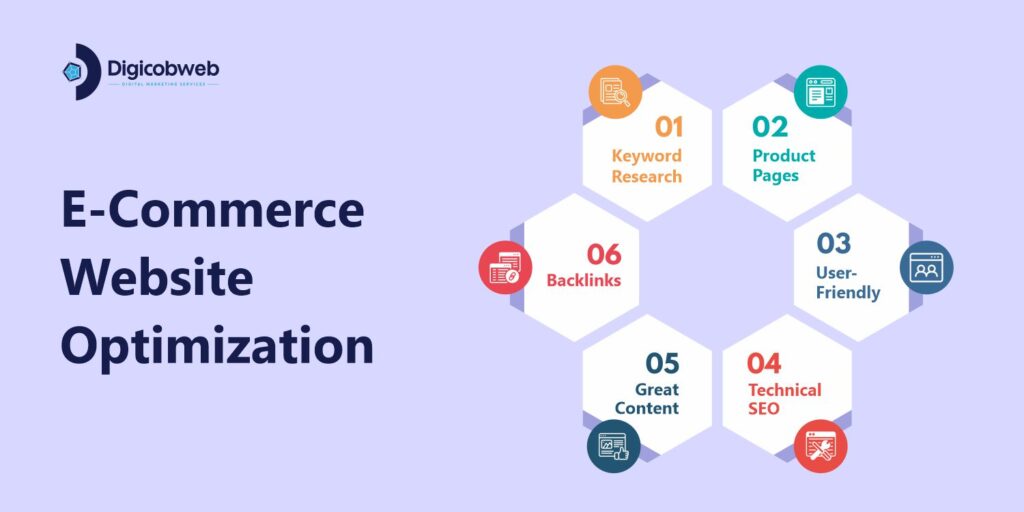
E commerece website optimization techniques

1. Get Smart with Your Keyword Research

ECommerce websites fail to prove their potential because every other online store uses the same old tactics. Remember, SEO is dynamic, and strategies keep evolving with time. What worked great earlier might not be the best practice for your store today. 

Most people will advise you to research keywords using a tool like Google’s Keyword Planner or locate keywords with the highest search volume and CPC terms. But that will not win the race. 

  • Use Search Intent-Based Keyword

We advise you to find the search intent behind every keyword you plan to use on your online store. This will aid you in ranking better on SERPs.

Even Google has started to give high priority to search intent-based keywords. The reason was to ensure that eCommerce stores do not abuse using keyword-spammy articles with little value or by paying for low-quality backlinks to their website. 

  • Synchronize the pages based on the Search Intent

While trying to create new webpages on your eCommerce store, the best thing to do is include search intent-based keywords for particular pages. For example, you can include keywords like Jewelry store that describe your business on the Homepage. 

Next, use mid-funnel keywords for category pages to give users a fair idea of the type of product they shop for, such as gold earrings. You can even include long-tail keywords here. You can include product-specific modifiers like golden earrings on the product pages. 

Keep the keywords that help resolve users’ problems in the articles and blog posts. For example, you can create a post like – 5 Most-Preffered Jewelries to Gift Your Partner This Valentine’s Day. 

  • Look Out for Keyword Opportunities

Try to answer specific questions that will help you get the essential keywords to target your customers and the store, like:

  • Who is likely to search for jewelry?
  • What occasion makes them search for jewelry?
  • What words are they using to search for jewelry?
  • Are there more searches performed on mobile devices or desktops?
  • What is making people search for jewelry?
  • Where is the exact location of the target audience?

The answers to these questions can help you find the pertinent search intents and topics to help you target your online store. You can commence by linking the existing web pages with every topic and intent. Then, start searching for keywords that can be used on every webpage.

  • Use Keyword Research

Now that you have a fair idea of associating keywords for each webpage, the next step is to use a keyword research tool to commence a list. We suggest using Semrush, Ubersuggest, and Ahrefs for keyword research. 

You should even use a Google search bar to suggest long-tail keywords that people use for jewelry. Next, use a Surfer SEO plugin to check the estimated monthly volume, CPC, and keyword difficulty. 

For already existing content, you can perform a content gap analysis to locate the keywords it is already ranking for and those it can use from competitor sites in the future. 

  • Give Priority to Your Keyword Targets

Once you have a list of keywords and their associated long-tail keywords, the next step is to examine the competitor keywords from the analysis done in the earlier step.

2. Optimize Your Product Pages to Climb on Top of SERPs

How often have you seen product pages on an eCommerce store that are not getting enough conversion rates? It is all because they are not appropriately optimized for search bots and their ultimate users. Here are some of the things that will help your product pages on an online store to get on top of SERPs:

First, you should use relevant, search-intent-based keywords that reflect the product page you are showcasing. You can use Google Search to get a fair idea of the right search-intent keyword for your specific product page.

  • Use Different Titles for Different Product Pages

However, never make the mistake of using similar titles for different product pages. This confuses Google’s algorithm, and they might penalize you over a long time.

The best resort is to ensure that no two titles are identical for any product page. Also, check whether the titles on the product pages are short and to the point. It should give readers a fair idea about your product in one glance. 

  • Write Creative CTAs

The CTAs on your product pages should be engaging and prompt users to take immediate action. However, do not use long sentences, as they do not help retain users’ attention spans for a long time. Never make your online store’s meta title and description long and confusing.

Ensure the H1 title you use resonates with the user’s search intent. Product descriptions should be search-optimized.

  • Use HTTPs in URLs

Finally, using HTTPs in URLs is a must to ensure your website’s security. Uppercase letters and special characters should be avoided at all times. Make sure that you optimize the eCommerce website for mobiles.

Encourage users to post reviews and ratings on your eCommerce store. Put customer photos and testimonials on your online store.

Always use canonical tags to ensure no duplicate content on your eCommerce store. Link related products and categories properly. Your store should have proper indexing for it to get reflected on search engines.

3. Design a User-Friendly eCommerce Site That People Love to Stay For Longer Durations

The first impression of your user is formed after looking at the design of your online store. Hence, it is best to design it considering your brand identity. Ensure that your store’s most critical data is above the fold. 

  • Excessive White Space

Lots of white space can distract the users, and they might stop browsing your online store. Hence, consider bringing items close together. Also, ensure that your online store has a minimalistic design so that it does not sound like an advert. Use industry symbols to ensure that your users are on the same page. 

  • Popup Windows

Popup windows are a thing of the past because they distract users’ attention. So, never allow a popup window when your users are about to shop from your online store.

  • Seamless Product Search Feature

The product search feature should be so seamless that users find the product of their choice effortlessly. This will help them stay longer on your store. To do that, enable auto-search functionality, sorting, and filtering results on your store.

  • A Simple and Straightforward Checkout Process

Finally, ensure that your online store’s checkout process is hassle-free. Most of the time, eCommerce store owners are guilty of having a lengthy checkout process that makes the users back out at the last minute. Don’t let this affect your sales figures!

Keep the checkout process simple with a few steps. Do not ask the users to log in to pay for the products. Provide different payment options so that users find their preferred payment method easily. These steps help users return to the store and see a repeat value.

4. Get Ahead with Technical SEO Enhancements

In 2024, we learned that technical SEO is one of the best tools to strengthen your eCommerce store’s global outreach. This includes crawlability and indexability. Everyone knows a page cannot rank until and unless it is indexed. Crawlers are software search engines like Google that are utilized to discover content online. Here are some ways to strengthen technical SEO on your online store.

  • URL Structure

First, pay attention to your store’s URL structure. Integrate keywords in the URL to ensure SEO optimization.

For example, if you have a jewelry store, we suggest using the term elegant jewelry to improve the URL structure of your store. The eCommerce store should be responsive using a mobile-friendly design. This is the last thing you can do for your online store.

  • Optimize Image Size

Optimize image size so that your store does not take long to load. Also, avoid unnecessary scripts and plugins.

  • Caching

We recommend using caching to reduce page loading time. Remember, Google considers these technical aspects crucial to ranking your store online.

  • Meta Title and Description Optimization

Using appropriate heading tags and optimizing your meta title and descriptions are essential. Use image tags, including alternative text, specifically to depict images.

Internal linking should also be done correctly. Use descriptive anchor text so that users know beforehand what they can expect after clicking on the URL.

Structured markups and schema.org are crucial aspects of technical SEO. Remember, reputed search engines like Google consider an online store without a sitemap dead.

  • Perform Local SEO

Remember to do local SEO, which helps your store appear domestically. You must provide your contact details and list your online store on local directories to do that. Add SSL certificates to ensure that any online hacker does not threaten your site. 

5. Great Content is Like Holy Gospel for Your eCommerce Website

Writing quality content is essential for e-commerce stores that are moving hard. This includes writing informative and persuasive blog posts to drive more website traffic.

Is using lots of keywords to rank your blog higher on SERPs no longer mandatory? o! The most important thing is to provide genuine answers to customers’ queries by resonating with their problems.

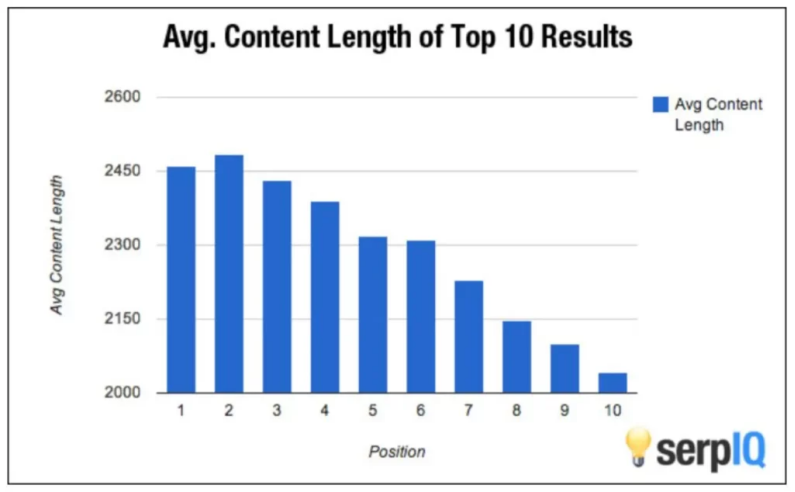
When discussing the word count ideal for online content, it is interesting to note that long-form content typically ranks better on SERPs. If you search for any blog on Google, you will find the top ten blogs, with more than 2000 words taking the top spot. 


The best thing you can do as a store owner is to affiliate with writers to create buying guides, listicles, and trending blogs that will enrich your audience and attract customers to your eCommerce store.

6. Build Credibility with Quality Backlinks for Your eCommerce Website

Backlinks are vital to making your content authoritative, relevant, and quality-driven in the eyes of your target audience.

So, the key is approaching authoritative domains in your industry and requesting that they exchange links with your content.  

The most important thing here is the relevance factor. There was a time when SEO professionals used to request any Tom, Dick, and Harry company to exchange links, but that practice is gone out of the wind today. Here are some white hat techniques to help you build quality backlinks for your eCommerce site.

  • High-Quality Content

Generate high-quality content to create curiosity in the minds of other players in your industry to associate with your brand. As suggested earlier, writing long-form blogs is the right approach to building the authority of your eCommerce store in your domain. 

  • Outreach to Reputed Bloggers

You can even contact bloggers in different niches and exchange links to build your credibility in the market. 

  • Perform a Competitor Analysis to find Broken Links

We suggest you take this approach to the next level by performing a competitor analysis and seeing whether there are any broken links. If you find several, approach the company and suggest how you can help them create quality-driven backlinks in exchange for replacing the broken ones. 

Common Mistakes to Avoid

Let us now look at some common mistakes eCommerce shop owners make while performing SEO on their online stores:

Not Keeping a Close Watch on Your Online Credibility

It is vital to monitor what people say about your brand, both positively and negatively. We do not mean to suggest that you always open the Google search bar to see what others are saying. But by setting a simple Google alert with your brand’s name or even your website address, you can receive notifications anytime someone speaks about your brand online. 

This helps you stay vigilant about your brand’s happenings and respond quickly to reduce any damages caused by anyone. 

Ignoring to Respond Negative/Neutral Reviews

It is typical for an eCommerce store to receive negative or neutral reviews. However, not replying to them or considering them might prove to be damaging to your online reputation.

The best thing you can do is to respond to the user and guide them so that you can achieve an amicable resolution. Once satisfied, you can ask them to delete the negative or neutral review.

Making the Purchase Process Overly Complex

Most eCommerce stores today are guilty of making their checkout process very complicated by including multiple steps. They even prompt the users to register. This wastes their valuable time and makes them move to another online store.

The best thing you can do to ensure this does not happen is to make the checkout process only a few simple steps. This will make the users enjoy shopping and visiting your online store repeatedly.

Improper Audience Segmentation

Every person has preferences, so an eCommerce store owner needs to consider them. Do that by using AI tools to set automatic product recommendations and provide suggestions to users based on their previous interactions on your online store. You can even set automatic recommendations like people also buy and best-selling products to make it easier for users to make the purchase decision.

Drive More Conversions by Making Your eCommerce Website SEO-Friendly Today!

Now that you know how SEO can help your online store, it’s time to start using these ideas. By making your website better for SEO, you’re not only making it easier for people to find, but you are also helping it sell more and do better. Every small change you make improves how people use your site and makes it more trustworthy. This ultimately results in more sales and happier customers. So don’t delay…Improve your website today and see your online store succeed in the busy online world!


The Power of SEO in Manufacturer Marketing

Did you know that 84 out of 100 people start their search for manufacturing services online? That is a significant number!

But here is something even more surprising: many manufacturing companies have not realized how powerful SEO for manufacturing companies can be for growing their business. SEO is like a hidden power that helps your company appear at the top of search results when people look online.

Don’t worry, though! We’re here to share some great SEO tips to help your manufacturing business stand out and ride the wave of online trends. Get ready to make your company shine on the internet!

What is SEO for Manufacturers?

SEO for manufacturers includes using the powerful combo of best practices and workflows to ensure that your manufacturing brand’s online visibility grows steadily. It also helps in attaining quality leads from prominent search engines.


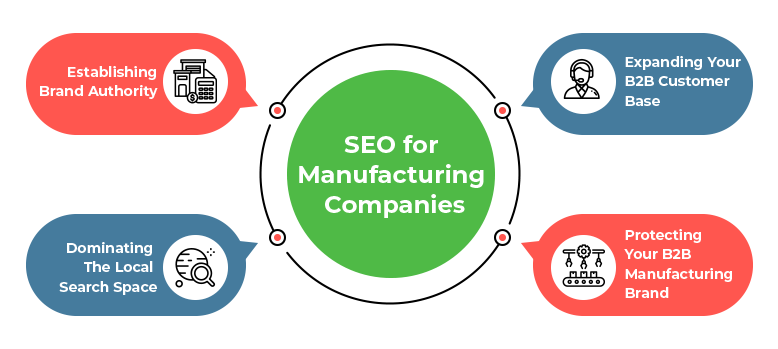
SEO for manufacturing companies.

Here are some of the tactics used by SEO professionals for a manufacturing brand:

  • Hiring a team of content writers to develop quality-driven website content and blogs
  • Making the already developed content on the website more optimized so that it gets the desired traction from SERPs
  • Collaborating with websites that are within and outside the industry
  • Conducting appropriate SEO performance scrutinization with the help of cutting-edge SEO tools

Since manufacturing businesses cater mainly to the B2B segment, content writers are often asked to write product descriptions, website content, and technical documentation to attract the desired attention of customers and businesses seeking their manufacturing services. This work enhances website performance and navigation, UX scrutinization, technical SEO audit, and strategic link building.

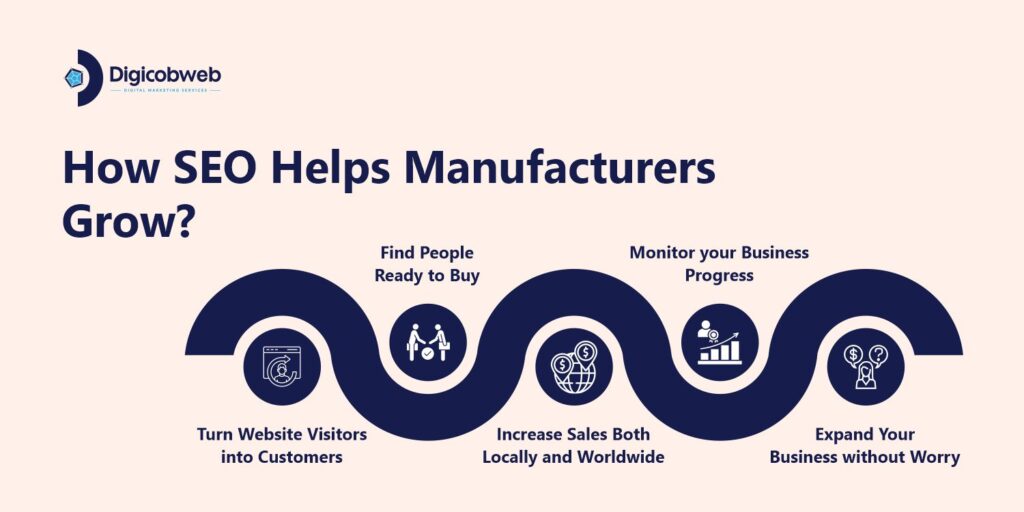
How SEO Helps Manufacturers Grow?

Here are some ways SEO can be decisive in taking your manufacturing companies to the next level.

seo for manufacturing companies guide

Turn Website Visitors into Customers

Today, most manufacturing companies have developed fully functional websites, but they are not able to convert these visitors into customers. This is where a prominent SEO company can provide helpful tips to generate more leads and convert your visitors into customers. 

Here are some of the ways:

  • Integrate forms on your website instead of mentioning email addresses.
  • Mention your mobile number in the top-right corner of your website header.
  • Add call-to-action so that your potential customers can get in touch with you from the website’s topmost portion on desktop and mobile devices (Many manufacturing brands are guilty of avoiding this functionality for mobile devices)
  • Have a chatbox added to your website. You should get the Livechat or Hubspot chat feature integrated.

Find People Ready to Buy

The great thing about manufacturing marketers is that they target specific niche markets. This makes it ideal for such brands to use high-intent keywords to reach their prospective audience. This includes B2B buyers looking for equipment or engineers searching for technical specifications. So, by putting in high-intent keywords, you can attract people ready to buy your products.

Increase Sales Both Locally and Worldwide

Nearly 50% of all Google searches are local. People today use search terms like where to buy and near me more regularly on search engines than ever before. Proper SEO strategies can enhance your sales figures locally and worldwide.

Monitor your Business Progress

SEO is straightforward to track and quantify in terms of results achieved. Hence, you know where your SEO efforts are heading as a manufacturing brand. You can also make course corrections if they seem fit. 

You can entirely depend upon general performance metrics for your manufacturing brand. Alternatively, you can comprehensively track customer funnels from the first search until they convert.

Expand Your Business without Worry

SEO helps you grow your business without any hassle. It does that by assisting you in generating B2B leads by attracting the attention of B2B researchers to your website whenever they make a final purchase decision. 

SEO also enhances organic searches, helping more potential customers learn about your offerings. This puts added pressure on retailers and distributors to hoard your products. This enables you to get new B2B leads in the pipeline, and this cycle never ends!

The Exclusive Art of Performing SEO for Manufacturing Brands to Attract the Right Buyers

Here are some of the ways to perform SEO for manufacturing brands that help to attract the right buyers:

Discover Keywords People Use to Search 

This is a crucial step when performing SEO activities for a manufacturing company. Here, the SEO professional tries to ascertain and target industry-specific search terms that customers use on prominent sites like Google during their buying cycle. 

SEO professionals can align content with your customer’s needs by understanding the search intent behind these industry terms. Ultimately, this enhances your content’s search visibility and draws qualified leads toward your website.

Here are some of the keyword research performed by the SEO professionals for manufacturing brands:

  • The first is the long-tail technical keywords, which primarily concentrate on the product features, manufacturing processes, or materials used in the product. For example, can a rubber part be manufactured to seal the leakage of steel piping? 
  • Next, the SEO professional targets terms that professionals in the manufacturing field commonly use.
  • Once that is over, the next step is to optimize the search for product model numbers and specifications. 
  • SEO professionals try to find out specific keywords related to the manufacturing industry that your product solves.
  • They even conduct local searches to understand the local lineage of your manufacturing product in the local market.

This step is crucial before a writer is assigned to create content based on the keyword. Such an exercise will significantly enhance your SERP rankings in organic searches.

Create Links to Improve Your Website’s Position

SEO professionals acquire high-quality backlinks from industry-acclaimed sources to enhance their websites’ domain authority and search rankings. Let us examine their different methods for building quality links for your manufacturing site.

  • Partnering with distributors, suppliers, and other complementary manufacturers to get mutual bartering of links. 
  • Get links from industry publications, event websites, and conference materials
  • Ask the technical writers to create case studies, whitepapers, and other cutting-edge pieces to get desired links from engineering blogs and industry forums
  • Link with industry-specific directories
  • Share your exclusive manufacturing processes or any advancements made in the industry by writing press releases
  • Linking internal to other pages of your website to improve the performance of content clusters

These link-building exercises can enhance the online visibility of a manufacturing brand and result in quality lead generation. 

Make Content That Brings in Business

Today, more than ever, it has become imperative for manufacturing businesses to create helpful, keyword-rich copy that provides valuable information about their services. This copy also assists website visitors in learning more about their manufacturing business using an effective SEO strategy.

The copy you ask your writers to create should be exclusive to every webpage of your website. Remember to provide adequate information by being descriptive so that both Google search bots and your audience like it. Always make it a point to place keywords organically in page titles, meta descriptions, and headings. 

Here are some of the content types that fit well with a manufacturing brand:

  • Blog posts and articles that explain the need for your product
  • Photos about the products that you are selling
  • Videos of the manufacturing process and your core team 
  • Product descriptions to provide adequate information about your products 
  • Case studies to give an overview of the challenges faced by your clients and how you overcame them through your products
  • White papers providing the detailed technical details of your product and its usefulness

Solve Issues on Your Website

The most important things for your manufacturing website (and manufacturing seo) are speed and user-friendliness in navigation. If both of these things are perfect, it signals to Google that your site is ideal for getting into SERPs. It enhances visitors’ browsing experience, prompting them to stay on your website longer. To learn your website’s exact speed, try Google’s free PageSpeed Insights Tool.

Making your manufacturing website mobile-first has become more critical than ever. This will help your website get traffic from different types of devices. To check whether your site is responsive, perform Google’s Mobile-Friendly Test today!

If you are looking for help getting a responsive design for your website, count on us to provide valuable SEO services to boost the visibility of your manufacturing website.

Stay Ahead by Keeping an Eye on Competitors

Manufacturing companies have been guilty of adopting the digital marketing trend quite late. Hence, this is your chance to ace this race by having an online portfolio on your website that your potential customers can quickly check and discuss the potential of affiliation in the future. 

Also, those competitors who have already adopted this trend will undoubtedly be the proclaimed frontrunners, but this does not mean that you cannot observe the keywords for which they are ranking higher and replicate their strategy to improve your organic search numbers. 

You should check how many of your competitors only use organic search and who runs ads on specific keywords using Google Ads. This will help you to catch up with them and improve your online traffic.

Increase Online Sales for Your Products

The ultimate reason for manufacturing companies to avail of SEO services is to acquire B2B leads and generate more sales. This can be achieved by getting the details of the numbers and evaluating how well your content works for your target audience. Here are some ways to check:

  • How many people clicked through your website after seeing it on Google SERP?
  • What is the average duration that your visitors stay on your website? How many web pages do they visit while on your site? This will help you understand whether your content is actually useful to visitors.
  • How many people filled out the contact form, downloaded gated content, or signed up for your newsletter?
  • How many potential leads converted into customers?

The answers to these questions will help you evaluate your content and take corrective measures if necessary. Certain web pages will perform excellently in generating quality sales leads, while others will drive subscribers to your newsletter. This keeps your cycle going to convert these leads into potential customers. 

Connect with Local Customers Easily

Most manufacturing companies fail to realize that the local market is the best way to enter their industry. This is where you can ask your writers to create pages targeting your city or region. 

We also recommend that you set up a Google Business Profile regardless of where your target audience is located. Try to get reviews from local listings. This will help build credibility online. 

We suggest optimizing the map pack listings for a specific region. This will help you get the desired traffic without much effort.

Connect With the Right Customers Using SEO for Manufacturers

SEO helps companies find the right customers, grow their business, and stay ahead of others. Companies can use tactics like proper keywords, better content, and checking progress to reach more people and sell more products. Start using SEO today to make your manufacturing business more substantial and successful.

6 SEO Trends That Will Future-Proof Your Search Strategy in the Age of AI

Guess what is new in online searching? Google has stopped something called Infinite Scroll. This means when you search for something, Google will only show endless results if you tell it to. They want to make sure you find what you need quickly!

Something exciting is also happening: AI, like a competent computer helper, is pushing Google to improve. Because of this, Google has to work hard to make online searching even better for everyone.

Get ready for something exciting: Almost half of companies using AI say their website rankings got better after Google updated its algorithms. This is a massive success for AI, proving it can compete in the quick world of online searches! And here is something else – about one in four people using AI believe the content it generates is more attractive and works better than human-written content at grabbing attention and keeping people interested.

The fantastic thing about SEO is that it is never constant. We are eager to see AI’s impact on online search in the coming year. As we wait for the new year, let us explore major SEO trends influencing search optimization in the coming years. Let us dive in!

Here are some of the SEO trends that will revolutionize how you search online in the new year:

1. Boosting Author Credibility Through N-E-E-A-T Optimization 

In January 2024, Danny Sullivan, who works with Google Search, tweeted about an article from The Verge. The article said that Google made websites add author names because of their guidelines:

NEEAT Optimisation

In SEO, showing who wrote something has become more critical because it helps create trust and makes the content seem more reliable. Google looks at author bios, qualifications, and links to professional profiles to decide which content should rank higher.

This idea fits Google’s N-E-E-A-T system (Notability, Expertise, Experience, Authoritativeness, Trustworthiness). Content linked to trustworthy authors meets all these criteria, making it more likely to do well in search results.

However, this approach isn’t perfect and is changing quickly. Let us look at it in a table to understand how authorship worked in 2024, what will happen in 2025, and what it means for SEO professionals.

Limitations of the Authorship Trend

Tough Start for New Writers

If you are new, showing you’re good at what you do can be challenging. Experienced writers already have an advantage, making it harder for beginners to get noticed.

Focus on Specialized Areas

Showing expertise is very important for topics like healthcare or legal advice. However, not all fields feel the same need to focus on being an author.

Need for Technical Knowledge

Being an author involves precise implementation of schema markup and technical SEO, which can be difficult for smaller businesses without the right resources.

Preference for Well-Known Names

Rankings might be dominated by more prominent companies and famous experts, making it less likely for smaller voices to be heard.

What It Means for SEO Professionals?

In 2025, SEO experts will have to do many different jobs. Simply concentrating on keywords or backlinks will not be enough. They will need to focus on creating and promoting author profiles. This includes:

  • Assisting clients or team members in writing detailed bios that highlight their qualifications.
  • Making sure structured data, such as author schema, is used correctly.
  • Keeping an eye on how authors are perceived online across various platforms.
  • Helping new content creators learn how to build trust and authority in their area of expertise.

2. Voice Search and Long Tail Keywords Will Drive SEO Searches Going Forward

Around 21% of people use voice search regularly, making it a regular part of their week. Voice searches are usually longer in duration and more detailed than typing. This means your content should have long-tail keywords…Phrases more specific than short, general words. For example, if you sell jewelry, it is better to concentrate on the keyword – handmade sterling silver charm bracelets -and not silver jewelry.

Demand cruve of monthly search

Using longer, more detailed words or phrases can make your business more noticeable in voice search results. Many websites still use shorter, more common words for typed searches and don’t take advantage of these longer phrases.

Longer phrases are not only good for voice search, but they also help catch the attention of people looking for specific things. The more specific and clear your content is, the easier it is to use several popular words or phrases together.

Challenges with Voice Search and Long-Tail Keywords

Difficulty in Forecasting All Searches

People talk differently from how they type. Voice searches can be very detailed or quite varied, making it tough to guess and prepare for every option.

Slow Process of Making Content

Creating material that answers specific, chatty questions can be very time-consuming. You have to write in a way that sounds natural, which often means changing how your website is set up.

Need for Technical SEO Skills

Voice search depends heavily on organized data, including schema tags, to help search engines comprehend your content. However, not all businesses possess the tools or know-how to do this properly.

Strong Competition

As more companies improve their voice search strategies, the fight to appear for detailed long-tail keywords becomes more complex. If you start late, it will be challenging to catch up.

 Risk of Overdoing It

Putting too much effort into voice search could result in over-optimization, where the content seems awkward or unnatural for people reading it on screens.

Impact of Voice Search and Long Tail Keywords on SEO Professionals

Voice search is becoming more critical for people who work in SEO. It’s both a chance to do better and a difficult task. Here’s what’s changing:

SEO experts must understand what people want and write content that sounds like how people talk. It’s not just about using certain words—it’s about giving clear and quick answers to questions. 

Professionals will create more FAQ pages, blogs that feel like conversations, and websites that are easy to use for voice searches.

  • SEO experts will need to learn how to use schema markup to help search engines find and show content that works well with voice searches.
  •  It will be very important to keep track of and understand voice search questions. Experts will have to watch how people use voice search to stay ahead of others in their field.
  • Many companies don’t understand the importance of voice search. SEO experts will need to explain to clients why spending on long-tail keywords and improving voice search is a good idea.

3. Local SEO Steps into the Spotlight

Local SEO statistics for 2024

A massive 76% of people search for “near me” every day to find businesses close to them! This shows how important local SEO has become on platforms like Google. For businesses, it’s now more important than ever to use local SEO strategies to get noticed in their area and bring in customers both online and in person. By making sure they appear in local searches, businesses can establish connection with people actively searching for their products or services in close proximity, giving them a big advantage in the local market. 

Limitations of Local SEO

More Competition

As more companies work on local SEO, it will be harder to stand out in a busy market.

Importance of Reviews

Customer feedback strongly affects local search rankings, and bad reviews can lower a business’s visibility.

Regular Updates Needed

Local SEO needs continuous care, like keeping business hours, contact info, and services current.

Voice Search Challenges

With more people using voice search for local info, businesses must optimize for natural, chat-like phrases, which is more difficult.

Algorithm Updates

Google often changes its local ranking rules, making it tough for businesses to keep stable rankings.

Impact on SEO Professionals

For SEO professionals, the dominance of local SEO creates both opportunities and challenges:

  • There will be more demand to study local search patterns and user actions to improve strategies and get better results.
  • They need to make sure their clients’ information is set up for smaller, specific areas.
  • Managing and replying to reviews will be important to keep good reputations.
  • They must regularly check and update Google Business Profiles with correct details, like holiday hours or service options.
  • SEO experts will need to change their plans to handle voice-based local searches, which are usually more conversational and detailed.
  • There will be more demand to study local search patterns and user actions to improve strategies and get better results.

4. Video SEO Will Emerge as a Standard Practice

Video marketing has helped 87% of marketers reach their audience and boost sales. Here’s a simple explanation of how companies make videos to attract potential customers:

video creation types by orgaisation

Many companies now make short videos, usually under two minutes, to attract customers and reach new people. This shows that videos are very important for marketing in all kinds of businesses. How often do we see videos on Instagram or LinkedIn that make us want to share them with our friends and coworkers? That’s the power of video marketing. In the coming year, video marketing can be very successful, especially if you use good SEO strategies to get long-term benefits.

Limitations of Video SEO

Expensive and Time-Consuming Video Production

Making high-quality videos can cost a lot of money and take a lot of time. Companies might find it hard to compete if they don’t spend money on good equipment, editing, and production.

Understanding Video SEO

Video SEO involves many things like how long people watch, how often they click on the video, and how much they interact with it. Figuring out and improving these complex parts can be difficult.

More Competition

As platforms like YouTube, TikTok, and Instagram keep growing, there’s a lot more video content. This makes it tougher to get noticed.

Too Much of Meta Data

Making video titles, descriptions, tags, and thumbnails better needs a lot of work and ideas. If you don’t do this well, fewer people will see your videos.

Accessible for Everyone

Making sure everyone can watch your videos, like adding captions or subtitles, is important but takes more time for creators.

Impact on SEO Professionals

SEO experts will need to learn how to optimize videos, which means using the right words in titles, descriptions, and tags. They should also use advanced methods, like adding time markers for search engines.

  • SEO experts must keep up with changes in how video platforms rank content, especially as AI and machine learning play a bigger role.
  • Since videos are popular on YouTube, TikTok, Instagram, and other sites, SEO professionals must make special plans for each platform while keeping the brand’s message the same.
  • SEO experts will need to work closely with creative teams to make videos interesting and good for search engines.
  • Video SEO won’t work alone. SEO professionals will need to mix videos with blogs, landing pages, and social media posts to create a complete content plan.
  • SEO experts must keep up with changes in how video platforms rank content, especially as AI and machine learning play a bigger role.

5. Featured Snippets Will Continue to Consolidate Their Strong Domination

Featured Snippets, or zero searches, have become a prominent feature on Google SERPs. In fact, you will be surprised to learn that 12.3% of search queries contain featured snippets. Such has been the dominance of featured snippets. In 2024, 99.58% of featured snippets acquire ranks from one to ten on the Google search engine.

featured snippet statistics

So, what does this mean for global businesses? Love it or hate it but you cannot ignore the significance of making your query ranked on Google SERPs. In fact, every time you search for anything on Google, chances are, you will find a featured snippet on top of SERPs for about 12.3% of search queries. You will find 99.58% of featured snippets finding a prominent place in the first-page SERPs. This goes to show that the passion to get your write-up ranked on featured snippet will still be on the top-priority list of companies moving into the new year.

Limitations Faced while Trying to Get Your Write-up Ranked on Featured Snippet

More Businesses Want the Best Spot

Featured snippets are at the top of search pages, so it’s very hard for companies to get this spot. Only one result is shown, so others have less chance to be seen.

Fewer Clicks to Websites

Featured snippets give quick answers, so people don’t always need to click on a website. This can mean fewer clicks, especially for content that just gives information.

Relying on Google’s Algorithms

Google chooses which content appears in snippets, and its rules can change often. Companies have little control, so it’s tough to stay visible in these snippets.

Voice Search and Featured Snippets

Using voice assistants to get answers often relies on featured snippets. Making your content visible for both voice search and snippets can be challenging and require a lot of effort.

Restricted Content Types

Although Google has added more types of snippets, there are still some restrictions. Content that is interactive or very visual may not appear in featured snippets.

Impact on SEO Professionals 

  • SEO experts should focus on organizing content for search results, like using clear titles, bullet points, and short answers to common questions.
  • It is important to know what users want and make content that fits what search results need, like answering “how,” “why,” and “what” questions.
  • Experts should find a balance between making content good for search results and getting users to click for more details.
  • SEO experts need to work with content writers to make sure the information is well-researched, interesting, and formatted for search result optimization.
  • Some industries might have special problems, like strong competition or difficulty in making content that works well for search results, especially for complex topics.

6. Prioritizing User Experience Will Become a Non-Negotiating Priority in Search Optimization

user experiance hierarchy

A single-second delay in loading your webpage can cause a drastic drop of 26% in your conversion rate. This shows that user experience is an essential component of the SEO strategy.

Today, users want their desired information seamlessly without foregoing their overall experience on your website. Hence, Google also observes how your users interact with the website, how your website functions, and the overall digital strategy you have employed to decide whether to showcase your website on top of SERPs.

In the mobile era, you cannot afford a website with poor aesthetics and a bad UX design. Even personalization has a role in delivering a great user experience on your website. The user experience factor will always remain a top priority of Google whenever they look to rank your website.

Limitations in Improving User Experience on Your Website

Integrating AR and VR in providing an immersive experience

Augmented and virtual reality will completely transform how users interact with digital content. This will prompt you to create more engaging and personalized experiences.

Changes in Creating Personalized Experiences for Users

The biggest challenge is integrating technologies like AI and headless CMS integration to streamline content delivery and provide personalized user experiences.

Including voice and conversational interfaces to provide a top-class digital experience

With voice-operated technology becoming a hit in 2024, the next step is to design UX that considers voice and conversational interfaces.

Embracing minimalistic designs and including micro-interactions

 This is the next level of user satisfaction that will take a lot of effort and time to deliver minimalistic designs through micro-interactions.

Using sustainable and ethical design

The biggest goal for digital entities is to ensure that they provide a sustainable and ethical design that has minimal impact on the global environment and develops users’ trust and loyalty.

Impact on SEO Professionals

  • Make sure that your website’s visitors can easily search for things they are looking for.
  • Compress images and use CDNs to speed up the performance of your website.
  • SEO professionals should prioritize mobile-first responsiveness to ensure that users get the best experience on their websites.
  • Make sure the website’s fonts are easy to read, with clear headings and sufficient white space to make the users’ experience top-grade.

The Future of Digital Search is Here!

Here you have it some of the trailblazing SEO trends that will make the new year even more special. If you want to learn more about the digital future of search optimization, you will enjoy this edition from us. If you would like us to include some more SEO trends for the year 2025, do let us know. We look forward to hearing from you. Keep motivating us by posting your invaluable comments below!


SEO for the Jewelry Business

Introduction

The jewelry market is crowded both online and offline. Shoppers no longer walk into stores by chance; they search, compare, and choose who shows up first on Google. That’s where 

seo for jewellery business becomes essential.


Google Maps results for local jewelry stores

Search Engine Optimization (SEO) helps jewelers appear in front of buyers who are actively searching for engagement rings, custom designs, or gold jewelry stores nearby. Whether you own an online shop or a physical store, SEO places your business ahead of the correct people at the correct time.

Throughout this article we are going to discuss how to apply SEO on jewelry websites in trying to get maximum traffic, have more customers, and create online awareness to real sales.

Why SEO is Essential for Jewelry Businesses

Let’s be clear. SEO is merely being ranked higher.

For jewelers, the best thing is to be in front of prospects when they search for the products. If a potential buyer is looking for the “best gold jewelry shop in Ahmedabad” or “custom diamond rings near me,” your page must rank ahead of those of your competitors.

Why SEO is essential for jewelry businesses and long-term business growth.

The following justifies the importance of jewelry SEO for sustained business success:

1. Your customers start their journey online.

Even if most jewelry purchases happen in-store, the discovery happens online. Ranking well means you’re part of that first impression.

2. Local SEO drives store visits.

Google Maps, reviews, and “near me” optimization drive high-intent store traffic.

3. Organic traffic is more cost-effective.

Whereas ads pay you money each time you’re watched, search traffic gives you visibility that lasts forever. In the case where you’re ranked, you can continue getting visitors without incurring the cost of the ads again.

4. SEO builds trust and authority.

Being top-of-mind in the search results round the clock is establishing your jewelry store as a trusted and credible one.

5. Mobile-first buyers rely on quick results.

Most people are browsing on cell phones, so cell phone-driven SEO optimization is creating the difference when it comes to sales and inquiries.

SEO for jewellery is not extravagance for serfs. It’s something you’ll want because of the way new jewelers are fighting it out with each other in this era of digital everything.

Top Jewelry-Specific Keyword Strategies

You can’t even start optimizing for what you have no idea about. For jewelers, never in a million years is it ever acceptable to optimize for broad-level terms such as “diamond rings” or “gold necklace.” You need to trim the keywords down by intent and by location.

Top Jewelry-Specific Keyword Strategies, covering search intent, long-tail keywords, keyword tools, and using both jewelry and jewellery spellings.

This is a detailed guide on how to develop an SEO strategy for your jewelry website:

1. Understand Search Intent

Each keyword is informing you about something the customer is attempting to do.

– Location keywords: “jewelry shop in Ahmedabad,” “bridal jewelry in Delhi”

2. Combine Product + Intent + Location

Employ hybrid keywords like

  • “custom gold jewelry Dubai”
  • “cheap engagement rings India”
  • “diamond jewelry SEO services USA”

These capture both relevance and local search traffic.

3. Target Long-Tail Keywords

The better the conversion rate, the longer the keyword will be.

For instance, instead of saying “diamond ring,” use “vintage diamond engagement ring for below ₹50,000” or “rose gold women’s engagement ring.”

4. Use Keyword Tools the Right Way

Google Keyword Planner, SEMrush, or Ahrefs tell us exactly what people are looking for. Don’t just pick high-volume keywords; pick buying intent keywords that fit your business model.

5. Balance Jewellery and Jewelry Spellings

To get visitors from the US as well as the UK, use both spellings organically in your content: “SEO for jewellery” and “SEO for jewelry websites.” It is a simple tweak that opens your door a bit wider.

6. Integrate Keywords Naturally

Place your single words into:

  • Meta titles and descriptions
  • Product descriptions
  • Blog subheadings
  • Image alt tags

Avoid keywording too much.

Google likes more readability and relevance than duplicates.

How to Do Competitor SEO Analysis for Jewelry Businesses

You need to know what is happening with your competition.

It alerts you to gaps, opportunities, and how-to’s for effective jewelry SEO. Competitive research isn’t plagiarism; it is finding what attracts visitors, leads, and sales to your market space.

Step 1: Identify Your Competitors

  • e.g., searching for “City jewelry store.”

Step 2: Analyze Their Keywords

  • Find out which keywords drive the majority of their website traffic.
  • Transactional and local keywords are emphasized, such as “custom engagement rings near me” and “gold bracelets online India.”

Step 3: Examine Their Content Strategy

  • Inspect what blogs work and why.
  • Inspect post length, content, and format.
  • Inspect usage of images, videos, and infographics, which are SEO considerations.
  • Inspect keyword usage in titles and meta tags.

Step 4: Check Their Backlink Profile

  • Quality backlinks indicate authority.
  • See what sites are linking to them.
  • Try to obtain links from similar high-authority sites, such as lifestyle blogs, wedding websites, and blogs.

Step 5: Evaluate Technical SEO & UX

  • Verify the site organization, mobile-friendliness, and page speed.
  • Check the organization of the site, mobile-friendliness, and page loading speed.
  • Find out what your site is superior to others in, such as faster loading and navigability.

Top Content Ideas for Jewelry SEO

Content is the foundation of SEO. Product copywriting has nothing in common with jewelers; it’s merely gaining access to content that ought to rank and convert.

Content for Jewelry SEO

How someone can produce great content for Jewellery Businesses:

1. Product Guides and Tutorials

2. Seasonal and Occasion-Based Content

  • Consider anniversaries, Diwali, wedding season, or Valentine’s Day.
  • Examples include “2026 Gold Jewelry Trends” and “Top 10 Winter Wedding Engagement Rings.”

3. Brand Storytelling and Craftsmanship

  • Backstage copywriting of artisan technique, sources, and design philosophy.
  • Example: “The Art of Handmade Jewelry in [City].”
  • It’s one of the jewelry search engine optimization solutions that create trust and credibility.

4. Visual Content Optimization

  • Trust people more in ways of pictures when it comes to jewelry.
  • Make use of high-quality images with keyword-stocked alt text
  • Short videos and video tutorials will engage people more and keep them on your site.

5. FAQs and Buyer Guides

  • Answer common questions that people ask:
    • “How do I determine my ring size?”
    • “If I have sensitive skin, which metals can I wear jewelry in?”
  • Structured data also assists your content in being found more in search results.

6. Linkable Content

  • Produce guides or infographics that other sites can link to.

Expert Suggestion: Cross-link content internally: link blogs to product pages and service pages to spread authority across your jewelry website SEO ecosystem.

CTA:

Struggling to create content that actually drives traffic and conversions? 

Our jewellery SEO services help you optimize your website, target the right keywords, and attract high-intent buyers.


How to Reach a Broader Audience Using SEO

SEO site optimization will never be enough alone. You require a full-funnel SEO strategy that periodically addresses all your customers.

How to Reach a Broader Audience Using SEO: The Jewellery SEO Growth Tree

1. Local SEO for Brick-and-Mortar Stores

  • Add business details, open hours, images, and posts to your Google Business Profile.
  • Get customers to review, as Google favors reviewed local businesses to appear in search.
  • Utilize location-based keywords, i.e., “custom gold jewelry Ahmedabad” or “bridal jewelry near me.”

Also Read: How to Rank a Local Business: SEO Tactics That Work

2. Long-Tail Keyword Targeting for Online Sales

  • Use long-tail phrases such as “rose gold engagement ring for under ₹150,000.”
  • They have a higher ranking because the consumer has definite buying intent.

3. Visual Search Optimization

  • As jewelry is a very visual product, you will need to get it optimized for Pinterest and Google Lens.
  • Use alt tags and file names in the images, i.e., “handcrafted-sapphire-ring-jewelry-seo.jpg.”

4. Multi-Channel Integration

  • Social media usage indirectly affects your SEO. Share the blog posts and wedding guide on Facebook, Instagram, and Pinterest.
  • Ask wedding bloggers and influencers for likes, shares, and backlinks.

5. Mobile-First Optimization

  • Ensure pages load in under 3 seconds.
  • Mobile-friendly navigation improves rankings and reduces bounce rates.

6. Monitor & Adjust

  • Utilize Google Search Console to monitor keywords utilized to send traffic.
  • Hit top-performing pages and refresh content to back anchor your ranks.

SEO Lifecycle for Jewelry Businesses

Good SEO process is a do-it-all-over-again model of planning, doing, analysis, and optimization. Jewelers at this cycle give them regular visibility, traffic, and income.


SEO Lifecycle for Jewelry Businesses -Proper Step By step

Step 1: Research & Strategy

Why it matters: 

Your SEO fails if you do not research. Data-driven and behavior-driven customer strategy enables you to connect with the target audience.

Implementation:

Instead of writing “gold rings,” consider “custom gold engagement ring for woman in Ahmedabad.”

Determine the demographics, purchase behavior, expenditure capability, and interests of your target consumers. It helps you choose the most suitable channels, content, and keywords.

Observe their backlink profile, best content, and site architecture.

Deliverable: 

Keyword strategy, content ideas, and competitor results expressed in an SEO plan.

Step 2: On-Page SEO Optimization

The key goal of on-page SEO is optimizing every page as much as possible for users and search engines. It will help improve your rankings and have more people interact with your content.

Detailed Actions:

Example: “Custom Engagement Rings | Expert Jewelry SEO Services | DigiCobweb.”

  1. Headings Layout (H1-H3): Have only one H1 for each page on the keyword and separate the content into H2 and H3 for easy explanation and usage of keywords.

Example:

H2 “How to Select a Diamond Ring”

H3 “Things to Keep in Mind About Cut and Clarity”

Make liberal use of keywords and respond to typical customer questions. Refrain from duplication of the same sentences.

custom-rose-gold-diamond-ring-jewelry-seo.jpg

This gets your site user-friendly and passes control through your site.

Step 3: Technical SEO

Technical SEO ensures search engines can crawl, index, and understand your website efficiently, while also improving user experience.

Key Areas for Jewelers:

  • Mobile Optimization: Ensure responsive design with fast-loading pages. Most jewelry shoppers browse on smartphones.
  • Site Speed: Compress images, minify CSS/JS, and leverage caching.
  • HTTPS Security: Protect customer data and improve trust signals.
  • Sitemap & Robots.txt: Submit XML sitemaps to Google and ensure correct indexing rules.
  • Structured Data: Implement Product, FAQ, and Breadcrumb schema for rich snippets in search results.
  • Fix Broken Links/Duplicate Content: Avoid errors that harm rankings and user experience.
  • Website Architecture: Organize categories and product pages clearly to make navigation intuitive for users and crawlers.

Step 4: Off-Page SEO

Off-page SEO decides your site’s credibility.

Best Practices:

  • Building Backlinks: Obtain backlinks from wedding blogs, lifestyle blogs, and fashion magazines. Quality over quantity.
  • Local SEO: Claim and create a Google Business Profile, write reviews, and place consistent NAP data in directories.
  • Content Marketing: Encourage guest bloggers and influencers to share your posts and share your content on social media with the aim of reaching as many as possible and acquiring backlinks.
  • Press Release and Document Sharing: Publish new collection, award, and event releases to trustworthy publications with the aim of acquiring more backlinks.

Outcome: 

More traffic, improved search ranking, and more user trust in search engines.

Step 5: Measurement & Reporting

Tracking performance allows you to see what works and optimize continuously.

Steps:

  • More traffic, improved search ranking, and more user trust in search engines.
  • Steps: – Monitor keyword position in GA4 and Search Console, website traffic, conversion, and bounce rate.
  • It’s necessary to check backlinks, domain position, and top-performing pages using Ahrefs or SEMrush.
  • Tag underperforming content and, with the data available, fix or re-optimize it.

Step 6: Continuous Optimization

SEO is never done; it has to be renewed every now and then in order to keep up with competition, search behaviors, and algorithm changes.

Tactics:

  •  Refresh seasonal content, e.g., holiday promotions or wedding preparation articles.
  • Resubmit old blog articles to refresh and send to a better destination.
  • A/B test call-to-action and meta title and landing page differences.
  • Spy on competitors and find new keywords in the category “jewelry.”

Result: 

An in-house system that provides day-to-day traffic, leads, and sales.

How to Optimize Your Content for Mobile E-Commerce

Mobile commerce is the most important sector for jewelers since the majority of the customers shop and compare their products through mobile phones.

How to Optimize Your Content for Mobile E-Commerce

1. Mobile-Friendly Design

  • Use responsive design that adjusts based on screen size.
  • Design the product images in a way that they appear great resized and CTAs are clearly apparent.
  • Don’t use pop-ups that break navigation or product pages.

2. Page Speed Optimization

  • Optimize product images without compromising definition.
  • Update seasonal material, like holiday offers or wedding guides.

3. Navigation & User Experience

  • Simple one-tap navigation through plain, uncluttered menus with categories.
  • Plain html calls-to-action: “Add to Cart,” “Call Now,” and “Request a Quote.”
  • Simple product filtering and sorting.

4. Mobile SEO Best Practices

  • Local search is optimized on keywords such as “custom gold ring [city]” and “bridal jewelry near me.”
  • Product, price, and availability schema data.

5. Advanced Optimization

  • Accelerated Mobile Pages (AMP) for blog articles.
  • Progressive Web Apps (PWA) will be more user interactive with offline storage and instant page reload.

Also Read: Crack the SEO Code for eCommerce Website Optimization Using These Tips

Best Tools to Measure SEO Success

Seo performance tracking is necessary to see if your efforts pay off, on what aspects work needs to be done, and how your online jewelry store can be better. etailed explanation of tools and application comes next:

Best tools for measuring SEO Success

1. Google Analytics 4 (GA4)

  • Monitor user behavior, conversions, and traffic source with Google Analytics 4 (GA4).
  • Find the most engaged pages and sales pages.
  • For example, check what product pages or blog articles are most likely to be driving the most jewelry searches or buys.
  • Provide conversion tracking to monitor eCommerce sales or natural search leads.

2. Google Search Console

  • Monitor CTR, clicks, impressions, and keyword positions.
  • Find broken pages, site issues, and indexing issues.
  • Audit what search terms drive your jewelry website SEO pages and content and content-optimize accordingly.

3. Ahrefs / SEMrush

  • Run backlink analysis and competitor analysis.
  • Check who your competitors are ranking for.
  • Monitor keyword history performance and domain rank.

4. Screaming Frog SEO Spider

  • Audit the site for technical SEO issues like missing alt tags, duplicate pages, broken links, and meta tag issues.
  • Critical to checking good site structure, particularly on larger eCommerce jewelry sites.

5. PageSpeed Insights & GTmetrix

  • Verify page load speed and performance.
  • Recommends actionable suggestions to minimize page size, image compression, and mobile usability.
  • GA4 for behavior 
  • Search Console for search performance
  • Ahrefs/SEMrush for competition
  • Screaming Frog for technical health

Common SEO Mistakes Jewelry Businesses Make

SEO mistakes can happen even to experienced jewelers. 

Common SEO Mistakes Jewelry Businesses Make

Don’t waste time, money, and lost traffic by committing the following mistakes:

1. Keyword Stuffing

  • Excessive unnecessary stuffing of information with “jewelry SEO” will make information impenetrable and kill rankings.
  • Instead, include primary and secondary keywords naturally in content.

2. Duplicate Content

  • SEO is harmed by duplicating another’s effort or product description plagiarism from a manufacturer.
  • Write original blog posts, tutorials, and product descriptions for your company.

3. Ignoring Image SEO

  • Jewelry is a visual business. Not using alt tags or sloppy implementation detracts from search visibility.
  • Optimize keyword-rich, descriptive alt tags on all product pictures.

4. Neglecting Local SEO

  • Jewelry shops mostly overlook serving local customers through being overly concerned with global SEO visibility.
  • Directory NAP record updates, Google Business Profile optimization, and review encouragement.

5. Poor Technical SEO

  • Poor mobile experience, crawl problems, duplicate material, and page lag all cast a shadow over rankings and conversions.
  • Regularly audit and fix technical issues to maintain a healthy website.

6. Ignoring Analytics & Tracking

  • Trailing traffic, conversions, or keyword rankings is blind flying.
  • Get GA4 and Search Console right and review monthly reports to inform strategy.

How to Integrate SEO with Other Marketing Channels

SEO is never in isolation. When integrated with other marketing efforts, it’s an even greater force and sustainable brand presence:

How SEO Connects with Other Marketing Channels

1. Social Media Marketing

  • Pin blog entries, product details, and images to Instagram, Pinterest, and Facebook.
  • Pinterest is especially effective for jewelers since customers are looking for inspiration.
  • Social media shares push traffic and can rank indirectly.

Also Read: Social Media Marketing for the Jewelry Business

2. Email Marketing

  • Release SEO content in the form of a newsletter, like guides or blog posts.
  • Use backlinks to optimized landing pages with a view to marketing new ranges or season collections.
  • Use the example of running traffic and sales for a Valentine’s Day promotion, which will go to a blog post titled “Top 10 Engagement Rings.”

3. Paid Advertising (Google Ads / Social Ads)

  • Maximum SERP visibility and top natural ranks are two sides of the same coin when dealing with pay-per-click advertising and SEO.
  • Use high-intent keywords to drive and anchor search memory with the brand.

4. Offline Marketing & Events

  • Promote online, launch, and market news.
  • Drive traffic back to your site for optimal SEO value and lead capture.
  • Example: Host a “Custom Jewelry Design Workshop” and blog about local search engine optimization.

Key Insight: End-to-end marketing is constructed by multi-channel integration, wherein SEO drives other channels and other channels drive SEO.

Next Steps for Jewelers:

Proper SEO can transform your jeweler’s web presence and sales. 

Your 5-Step SEO Action Plan

Let’s walk through step by step:

Step 1: Audit Your Current Website

  • Make sure your existing site is technically sound, mobile-friendly, keyword-rich, and of high quality.

Step 2: Define Target Keywords

  • Select primary, secondary, and long-tail keywords for information, local, and product content.

Step 3: Implement SEO Lifecycle

  • Conduct technical, off-page, measurement, on-page, and ongoing optimization activities.

Step 4: Optimize Mobile E-Commerce

  • Offer usability, structured data, mobile site speed, and one-click checkout.

Step 5: Measure Performance & Refine

  • Monitor keyword position, traffic, and conversion.
  • Tweak content frequencies, experiment with variations using analytics, and observe how the competition will respond.

Step 6: Consider Professional SEO Services

  • For jewelers in need of quicker results, jewelry SEO services can provide full-sized audits, strategy, and manual implementation.

Conclusion

SEO is no longer a jewelry luxury; it’s where your business is discovered, trusted, and purchased online. You can build a standalone site driving traffic, leads, and conversion with an affordable SEO process using technical audits, off-page research, on-page optimization, and continuous optimization.

Key Takeaways for Jewelers:

  • Optimize with the proper keywords: To maximize return, use intent-based, geography-based, and long-tail keywords.
  • Create content that’s rich: Guides, tutorials, and blog posts educate customers and establish confidence.
  • Optimize your website for tech- and mobile-friendliness: Make it responsive, beautiful, and fast-loading.
  • Use multi-channel marketing: Email, pay-per-click, and social media all supplement SEO to drive more returns.
  • Track, analyze, and optimize: Weekly reporting enables you to make changes for constant improvement.

So, your website will not only be seen but also be a real jewelry buyer website, local and worldwide. Web business website or boutique shop website, not even a little bit; Jewelry business SEO management means long-term success as well as quantifiable results.

5 Action-Oriented Digital Marketing Trends That Will Make 2025 a Blockbuster Year

Want to hear something interesting? This year, short videos on social media were super popular! Have you ever watched a one-minute video you just had to watch again because everyone loved it so much? Here is something surprising: even though some people still use old and boring ways to promote things, 44% of people used short videos on social media to make their success grow fast. That’s pretty awesome, don’t you think?

learn about product and services via different mediums

And that is not all…Over half of the world’s population used voice search daily last year! How great was it to relax and simply say, “Hey Siri, play my Spotify playlist,” without lifting a finger?

Industries using voice search feature

Also, we have seen some amazing things with AI…Think about a smart robot that knows how to organize customers, create personalized messages for them, and handle social media like an expert. Now, get ready because I have some incredible numbers to show you how much this technology has helped!

The startling thing is digital marketing will soar to new heights annually by 9% from 2020 to 2026! Another glaring statistic is that social media accounts for 33% of all the money spent on digital marketing. Even more amazing is the expected value of the SEO industry in 2024, estimated to be a huge $90 billion!

digital ad spending

You might want to reconsider if you believe digital marketing and SEO might struggle because of AI tools like ChatGPT and Google’s Bard AI. We are rooting for even more amazing technology to turn up in the next year as the holiday season kicks in and Christmas songs fill the air. These advancements promise to make 2025 even more exciting. Are you excited to join us on this bandwagon of thrilling extravaganza?

Digital Marketing Trends That Will be Talk of the Town in the Year 2025

Let us now look at the digital marketing trends that will power through 2025 like wildfire:

1. Cupid Finally Strikes Between Marketing and AI & ML 

The AI market is expected to grow by 26% this year after a 47% increase between 2021 and 2025, marking soaring growth. The gradual surge indicates a promising upturn. Experts in AI and machine learning will see a significant rise in demand. Roughly 100 million new marketing positions will be available early next year.

AI/ML Statistics from 2019 to 2025

This shift indicates a new phase in marketing, where understanding and utilizing AI is crucial for staying competitive. Here is a comparative study that will give a fair idea about where AI & ML will advance in marketing in the coming year.

comparative study about where AI & ML usage

Limitations of this Fusion:

Data Privacy Regulations

With governments worldwide strengthening data privacy laws, marketers will face challenges in collecting and using data. This will limit the scope of personalization and customer insights derived from AI.

Ethical and Bias

An AI is only good to the degree of its data, which is very much biased by humans. Ethical concerns about AI-driven fairness and transparency become critical in affecting consumer trust.

Technical Complexity and Integration 

As AI and ML technologies increase in sophistication, they have also become more complex in terms of integration and management. Marketers may find technical requirements complex in terms of integration and management. Marketers may find technical requirements challenging to meet, requiring them to depend on experienced IT professionals.

Higher Prices of Next-Generation AI Technologies

While implementing high-level, sophisticated AI solutions may be extremely expensive, small to medium-sized enterprises cannot afford all the expenses. This will widen the gap between leading and smaller players.

Over-reliance on AI

It will make marketers less involved in the creative aspects, and there is a possibility of getting disconnected from the reality of the market. This will negatively impact the brand’s innovation beyond AI suggestions.

2. A Bold New Perspective of Google Search

Google Overview summaries will cross over 1 billion active monthly users in over 100 countries, evolving the role of search engines. This will change user interactions and create new challenges for marketers. 

Google, to date, remains at the top. However, 2025 will introduce a diverse AI-powered search ecosystem. This includes tools like SearchGPT (Bing-powered), Perplexity, and Claude AI, making their presence felt globally. This will make the search landscape more complex. If Google has to retain its number one spot, it must improve its presence on all platforms by closely monitoring how users are now finding websites.

Webpage visits per month per desktop user, Google vs. Ai sites

Source: Smart Insights

As these new search platforms grow, businesses must cast a wider net while maintaining their Google presence.  

State of SEO 2025 Report

This might mean that they optimize for natural language queries, making sure the information is structured in such a way that it is easy for AI algorithms to digest and focusing on value-added insights rather than just being fact-based. Here is a comparative study that will give a fair idea about where Google Search will end up in the coming year.

Comparative study about Google Search

Limitations as a Result of This New Role by Google:

Increased Complexity in SEO

As Google’s algorithms move to integrate AI and machine learning, the complexity of these SEO strategies will increase even more. Marketers must adapt faster to survive and be effective, requiring deeper technical understanding and continuous learning.

Privacy Regulations

With stricter data privacy laws such as GDPR and CCPA, marketers will face stiff challenges in collecting and utilizing consumer data for targeted advertising and personalization that could potentially limit search marketing effectiveness.

Voice and Visual Search Optimization

As voice and visual search grow, developing new content types and optimizing them specifically for those formats becomes more resource-intensive.

Ad Blockers and Searcher Fatigue

The enhanced use of ad blockers and growing searcher fatigue over ads could reduce the visibility and effectiveness of paid search campaigns.

3. Content Marketing Takes a Dynamic Turn

Generative AI tools for content marketing reshape the entire industry. Today, 89% of marketers use this technology to develop better content. Here’s a summary of how marketers are using generative AI to fine-tune content:

Usage of AI brainstorming by Marketers

However, satisfaction with the use is varied, with 17% of B2B marketers rating the AI-generated content as excellent or good, 44% saying it is okay, 35% rating it as fair, and 4% ranking it as poor. This tells us while AI tools streamline the content creation process, they still need improvement to guarantee that there will be continuous high-quality and engaging content.

Quality of content generated by AI

AI technology’s advancement will likely be even more crucial in content strategy development and execution. Let us look at how content marketing was performed in 2024 and what changes we can expect from the New Year.

content marketing performance compression

Limitations as a result of The Growing Role of Generative AI in Content Marketing:

Quality Control

Though developed, the quality check for AI-generated content remains an arduous task. The marketer should observe and modify AI outcomes regularly to ensure they remain free of low-quality content and have a face-to-face appeal.

Creativity limitations

AI will find it hard,  perhaps impossible, to be ‘inherently creative.’ Artificial creativity, by the formula, will only mean reproduction or repetition. Humans shall provide oversight to introduce quality inputs and make content engaging in human terms.

Relying on Technology

Overreliance on AI could make marketers too reliant on technology and, ultimately, suffer from a gap in more traditional content creation skills.

4. Emerging Platforms Propel Social Commerce Growth

Were you aware that a whopping 14% of all online shopping happens through social media? TikTok is leading the charge in this social commerce revolution, captivating the vibrant Gen Z crowd. 43% of Gen Z shoppers now start their product hunts on TikTok, bypassing traditional search engines entirely..

But that is not the most interesting thing: it is forecasted to reach an astonishing 39.5 million shoppers in the U.S. by 2026. But let’s be clear: social commerce is not just through TikTok alone; nearly 82% of consumers use multiple social sites to research and discover various products. That huge shift itself is forming the way and manner emerging platforms are powering the growth of social commerce both this year and into the next.

Social media platforms usage in 6 months

Unlike Gen Z, most Millennials purchase on Facebook.

Product purchase comparison on social media by Gen z vs millennials

Let us dive into this trend and see how these platforms are shaping the way we shop!

Shopping trends comparison

Limitations as a Result of The Growth in Social Commerce Due to Emerging Platforms

Platform Saturation

With more brands and marketers turning to social commerce, the competition for consumer attention will intensify. This could lead to higher marketing costs and lower ROI if strategies are not innovative.

Changing Consumer Behavior

As new features and technologies emerge, consumer expectations will also change for the better. Marketers will need to continuously adapt their strategies to meet these expectations, which can be both time-consuming and resource-intensive.

Technical Challenges

Implementing advanced features like AR and AI requires significant technical expertise and infrastructure. Smaller brands may struggle with the resources needed to compete effectively.

Dependence on Platform Algorithms

As social commerce relies heavily on platform algorithms for visibility, any changes in these algorithms could disrupt established marketing strategies, affecting sales and engagement.

5. The Path-Defining Role of AI in Semantic Search – From Semantic Search to Conversational Search

Today more than  50% of the global population uses voice search daily. The growth of conversational AI is changing how users interact with search engines. Rather than traditional keyword searches, users can engage in dynamic conversations with AI agents, making the search experience more intuitive.

Advances in AI are showing the way for multimodal search capabilities, allowing users to query across different data types, including video. This represents a significant opportunity, as video content accounts for approximately 80% of all data on the internet.

AI Powered search with diverse needs

Let us dive into this trend and see how AI is transforming semantic search in the current year and what we can expect from the next year.

AI transforming semantic search in the current year and will be in next year.

Limitations Due to Growth of AI in Semantic Search

Higher Expectations for Content Quality

As semantic search enhances, the quality of content will need to match higher standards set by AI algorithms prioritizing depth, accuracy, and relevance, increasing the pressure on content creators.

Technical Integration Challenges

Integrating advanced AI technologies with digital marketing tools and platforms will require massive technical expertise and resources. This could require massive technical expertise and resources, which proves a barrier for smaller organizations.

Which Trend Are You Most Excited About?

We have discussed five top digital marketing trends that will spread like wildfire in the coming months. If you want us to add more digital marketing trends, let us know by commenting below. We will gladly accept and incorporate your feedback in this write-up. 

Keep reading and boosting our morale!


Content Marketing For jewelers  

Introduction

jewelers can use strategies like jewelry content marketing to connect with their audience and distinguish themselves in a fiercely competitive market. 

In this way, jewelers who post relevant and inspiring materials can demonstrate their knowledge, attract attention to exclusive products, and create a devoted audience. 

jewelers can interact with their audience, increase website traffic, and increase sales using content marketing. It utilises platforms such as social media, email newsletters, and blogs. 

This strategy educates potential buyers about the brand or product. It can appealingly highlight the product’s benefits and artistry. 

In this blog post, we will explicitly explore and discover essential jewelry content marketing techniques.

What Exactly is Content Marketing?

Content marketing is used to deliver the knowledge and solutions your audience seeks. It entails creating pertinent articles, videos, social media postings, and more. The aim is to become a trusted brand and recognized authority in your industry. 

Content marketing differs from typical advertising in providing helpful content instead of outright endorsing things. It also facilitates the development of profitable actions and relationships with customers.

Key Benefits of Content Marketing For jewelry Business

In a competitive market, jewelers can uniquely present their products, connect with customers through content marketing, and foster brand loyalty. The following three key benefits of content marketing for your jewelry business: 

  • Greater Brand Visibility

By regularly posting excellent content, your jewelry brand may build a solid online presence and connect with a larger audience. 

  • Enhanced Customer Engagement 

Producing engaging content for blogs, social media, and videos fosters deep conversations with potential customers, earning their trust and loyalty. 

  • Increased Sales 

Using efficient content marketing techniques, boosting website traffic, and turning site visitors into customers can all help you expand your jewelry business.

Diverse Types of Content Marketing Strategies for Jewelers

Various content marketing techniques are available to jewelry companies. These include producing excellent visual material, interaction with audiences on social media, and the composition of educational blog posts and articles. 

Credibility and reach can both be increased by working with influencers. SEO strategies also guarantee that potential buyers can easily find your jewelry online.

Building Your Brand Voice and Crafting a Unique Identity

It is especially important to cultivate a distinct voice and personality to succeed in the saturated jewelry market. Here are some strategies to create a memorable and engaging brand presence:

  • Tell Your Story 

Explain the background and story of establishment of the brand and the foundational values that guide your brand. This personal touch makes them relate with the brand in a way that makes more sense to them as individuals.

  • Draw Attention to Your Specialty

Note that it is crucial that you demonstrate why your jewelry is unique. Promote that your creations are made with responsibly-sourced materials or that your designs convey a hidden message or purpose. 

This differentiation makes you different and attracts customers who are willing to associate themselves with anything unique and of high value as per their standards.

  • Establish an Emotional Connection

Help customers see how your products might be a part of their unique occasions and memories by using your content to arouse emotions.

Generating Captivating Visual Content for jewelry Business

jewelry companies must produce visually appealing material to draw in and keep consumers. Your work will stand out online with superior images that showcase your craftsmanship. 

  • Professional Photography 

Your jewelry will look more desirable to potential customers if you invest in professional photography that highlights its fine details and shine.

  • Dynamic and Immersive Videos

Create videos that captivate visitors by showcasing the elegance of your jewelry products in motion. 

  • User-Generated Content 

To build community and increase authenticity, get buyers to post pictures of themselves wearing your jewelry.

Using Social Media Platforms and Channels for Content Marketing

For jewelers to present their goods, interact with clients, and develop a devoted following, they must make the most of social media channels. These are three successful tactics for content marketing for jewelry business: 

  • Share Stunning Visuals 

To draw attention and accentuate minute details, share stunning pictures and videos of your jewelry.

  • Engage with Followers 

To develop a community around your brand, respond to comments, hold live sessions, and provide interactive content. 

  • Keep Promotions and Giveaways

Provide incentives for sharing and interacting with your content to boost user engagement and increase your audience.

Leveraging Blogging and SEO for jewelry Stores

jewelry shops can’t afford to ignore the importance of blogging and SEO to increase their online presence and attract new clients. These tactics of content marketing for jewelry will make sure that your exquisite pieces are found in crowded digital spaces. 

  • Increased Search Visibility 

Your jewelry store can acquire more organic traffic by using SEO tactics and content optimization that includes pertinent keywords to rank higher in search engine results. 

  • Establishing Authority

Write blog entries regularly to inform readers about jewelry trends, maintenance advice, and styling suggestions. This strategy will help in establishing your brand as a reliable authority in the field.

  • Encouraging Interaction 

Interesting blog posts promote conversation, disseminate insightful knowledge, and cultivate a devoted following around your jewelry line.

Interacting with Your Audience through Email Marketing

For jewelry companies looking to establish long-lasting relationships, email marketing is essential for audience engagement. Effective email campaigns can improve client connections and increase sales in the following ways: 

  • Developing Relationships

Develop targeted messages that capitalise on the buyers’ desires and consider their buying history to make the customers feel valued.

  • Showcasing New Collections and Offers 

To make the target audience open new products and purchase specific items, offer new jewelry collections, sales, and promotions in the email newsletters.

  • Encourage Feedback and Engagement

To build brand familiarity and understand potential customers’ satisfaction levels, inviting the subscribers to voice their opinions and share their related experiences will be preferable to create two-way communication.

Collaborating and Partnering with jewelry Influencers 

Working with influencers may increase the reputation and visibility of your jewelry brand in a crowded market. The following are some significant effects of collaborating with influencers on your business:

  • Increased Audience Reach 

jewelry-interesting fans of influencers are devoted to their advice, which gives you access to a larger, more active audience. 

  • Enhanced Brand Credibility 

Having partnerships with jewelry industry influencers strengthens your brand’s reputation because their support may attest to the quality of your offerings and artistry. 

  • Valuable Content Creation

Working with influencers helps you produce original and engaging content types that appeal to your target audience, such as sponsored posts, reviews, or themed photoshoots.

Enhancing and Optimising Your Content Strategy for jewelers

jewelry companies must refine their content strategy to increase engagement and conversion rates. Key actions to improve your strategy are as follows: 

  • Audit and Refine the Content

Assess current content to ensure it is practical and relevant, considering consumer preferences and market trends. 

  • Apply Best Practices for SEO

To increase search engine exposure and increase organic traffic to your website, optimise your content using relevant keywords and metadata. 

  • Use Analytics and Insights

Utilise data analytics to monitor performance indicators, pinpoint content categories that work well, and hone future tactics for best outcomes.

Tips and Best Practices for Jewelry Content Marketing 

Genuinely engaging with customers through content marketing can increase your presence. It helps position your brand as a reliable authority in your sector. For your plan, consider the following essential tips and best practices: 

  • Strategic Partnerships

To increase your exposure and reputation in the jewelry sector, collaborate with respectable marketing or related companies. Working together can increase the visibility of your items, attract new clients, and foster a sense of trust. 

  • Be Consistent

Develop a community around your business, engage with fans, and consistently exhibit your work on social media portals including Pinterest and Instagram. 

  • Stay Updated

To produce timely and pertinent material that speaks to the interests and preferences of your audience, keep up with current trends and seasonal themes.

Why is Digicobweb a Perfect Content Marketing Partner for Your Jewelry Business?

Do you want to use intelligent content marketing to grow your jewelry company? When it comes to jewelry industry knowledge, visually stunning storytelling, and a data-driven strategy for quantifiable success, Digicobweb is unmatched as your ideal partner. 

  • jewelry Industry Experience

Our content strategies focus on the insights of jewelry trends and consumers’ attitudes, ensuring proper interaction with your target audience in the field.

  • Visual Storytelling

We specialise in creating highly effective content material that will attract attention to the skillful work on jewel pieces of your brand. 

  • Data-Oriented Methodologies

We use analytics and SEO to optimise your content, improve exposure, and draw in organic visitors. This strategy guarantees quantifiable outcomes and a return on investment for your jewelry company.

Key Takeaways

jewelers can see a significant transformation with effective content marketing for jewelry. It highlights artistry and distinctive brand stories and builds strong consumer ties. jewelers can draw in new business and keep existing clients by continuously producing insightful and exciting material. 

This strategy not only increases the awareness and trust of the brand but also significantly increases business growth in a cutthroat industry. 

Retail jewelers can maintain success and satisfy customers in the ever-changing jewelry industry by positioning themselves as reliable authorities through constant innovation and adaptation of their content strategy. 

Are you all set to take the next step towards improving your jewelry business with content marketing? Hurry and contact Digicobweb today to begin crafting a content marketing strategy that stands as brightly as your best jewelry pieces!