Local SEO Services For Jewelers

Introduction

Are you a jeweller hoping to attract more local clients? If yes, then what your business needs are SEO services to increase footfall from customers and expand your store’s online visibility. 

You should make your website highly friendly to search engines so that local customers looking for jewellery-related products or services find you quickly. 

Your exposure and revenues can be significantly increased by SEO services for jewellery websites, which includes local keyword targeting and Google My Business listing optimization. 

We will go through the main categories and advantages of local jewellery store SEO in this blog, making you stand out in the community.

What Exactly is a Local SEO Service?

Local SEO services can optimise your online presence for customer acquisition from target regions. They include local content production, local search engine optimization, and website enhancement. These services assist in getting your company listed in local search results for customers looking for goods or services in your area.
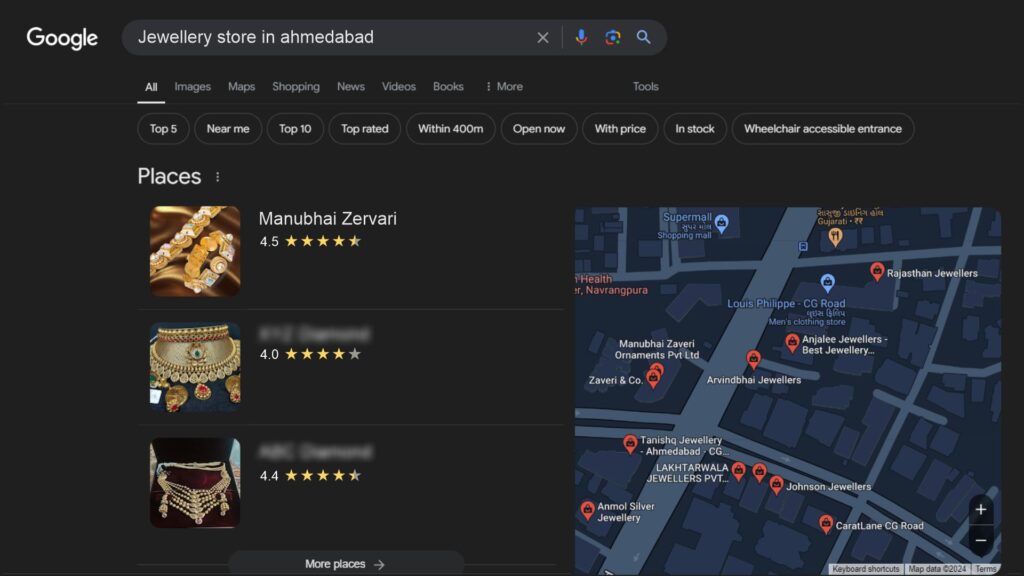
 

SEO for jewellery websites increases your visibility in your area through the use of correct business information and the targeting of local keywords. More local shoppers find your store as a result, increasing foot traffic.

Significant Benefits of Local SEO Services For Jewellers 

A jeweller’s visibility can be greatly increased, and more local clients can be drawn in with the help of SEO for jewellery websites. You can make sure that likely customers can quickly find your store by making the most of your internet presence. This is how: 

  • Increased Foot Traffic: Enhanced local search results drive more customers to your physical store.
  • Higher Conversion Rates: Targeted local keywords attract customers who are ready to purchase, increasing sales.
  • Improved Brand Awareness: Consistent online visibility helps establish your store as a trusted local jeweller.

Diverse Types of Local SEO Strategies for Jewellers

The jewellery store SEO strategy for the jeweller can rest on optimising the Google Business Profile to increase your local visibility. 

It may consist of creating local content to attract people in your immediate region and building links to increase your online presence throughout directories. Each strategy targets clients around you, increasing foot traffic and eventually boosting sales.

Website Localization 

Localization of a website means adjusting in content and design so that it adapts better to a specific culture and language. With this approach, the website attracts more engagement from the local audience.

  • Localised Content: Tailor text, images, and multimedia to reflect local culture and language.
  • Regional Keywords: Incorporate location-specific keywords into your content and metadata.
  • Local Currency and Measurements: Display prices and measurements in formats familiar to the local audience.
  • Cultural Sensitivity: Adjust design elements and language to align with regional customs and values.

Local Content Creation

Local content creation refers to relevant and engaging content for a more local audience. It improves the rankings in local search and assists in the engagement of potential customers locally.

  • Localised Blog Posts: Write articles about local events, news, and topics of interest to engage the community.
  • Community Spotlights: Feature local businesses, landmarks, or personalities to build local connections and relevance.
  • Local Guides: Create informative guides about the best local places, services, or activities to attract and assist local users.
  • Event Coverage: Post updates and highlights about local events and activities to capture local search traffic.

Local Link Building

Local link building involves gaining backlinks from local sites and directories to enhance your presence and authority in local search results. This approach strengthens your credibility and relevance within your local area.

  • Engage with Local Media: Partner with local news sites or blogs for features and articles that link back to your website.
  • Join Community Organisations: Obtain links from local chambers of commerce or business groups.
  • Sponsor Local Events: Sponsor or support local events and get backlinks in return on event pages and promotional material.
  • Partner with Local Businesses: Exchange links with other local businesses to increase your network and its visibility.

Google Business Profile Setup and Optimization

Improve your exposure to local search results, which entails developing and optimising your Google business listing. This procedure guarantees that potential clients can quickly access, read, and find the information about your site.

  • Claim Your Listing: To take control of and maintain your company’s information, confirm that you are the owner of your Google Business Profile. 
  • Complete Your Profile: Provide correct information in all fields, such as company hours, contact details, and website links. 
  • Add Images and Videos: To draw in the interest of potential customers, upload excellent pictures and videos of your goods, services, and store. 
  • Manage Reviews and Posts: Reply to reviews from customers on a regular basis and post updates about sales, occasions, or news.

Google Business Profile Posts Management

Google Business Profile Posts management involves creating and updating posts on your Google Business Profile to engage local customers. It helps in sharing timely information and promotions directly in local search results.

  • Regular Updates: Post regularly to update your audience about new promotions and events. 
  • Promotional Content: Draw attention to exclusive offers and savings to draw in more clients. 
  • Engaging Media: Make use of pictures and videos to draw viewers in and encourage interaction.
  • Performance Tracking: Monitor post-performance to refine strategies and improve results.

Google Business Spam Fighting

Google Business Spam Fighting involves identifying and removing fake or misleading listings to protect your business’s online presence. SEO services for jewellers ensure accurate information is displayed to potential customers.

  • Monitor Listings: Regularly check for fake profiles or incorrect details.
  • Report Spam: Use Google’s reporting tools to flag suspicious entries.
  • Verify Authenticity: Confirm that all reviews and business data are genuine.
  • Update Information: Keep your business details current and accurate to prevent misuse.

Building Local Citations

The local citation building is the listing of your business under NAP: name, address, and phone number on different online directories. This builds credibility and puts your listing on top of local search results.

  • Directories: To list your company, look for regional and industry-specific business directories. 
  • NAP: Make sure that all platforms use the same phone number, address, and business name. 
  • Provide Correct Information: Complete your profiles with precise and in-depth company data.
  • Monitor for Errors: Regularly check listings for accuracy and update as needed.

Managing Local Citations

Citation management involves checking that all your local business information across various online directories and platforms is correct and consistent. Regular updates and monitoring help maintain robust and error-free SEO.

  • Audit Regularly: Check all citations to ensure accuracy and consistency.
  • Update Information: Correct any outdated or incorrect business details promptly.
  • Monitor Listings: Track and address any changes or inaccuracies in your citations.
  • Respond to Issues: Quickly resolve any discrepancies or errors reported by users or directories.

Reputation Management 

Reputation management simply means checking and influencing how the public views your business. It helps to build trust and rectify negative feedback.

  • Monitor Reviews: Regularly check customer feedback across various platforms.
  • Reacting to Feedback: Handle reviews, whether favourable or unfavourable, with professionalism. 
  • Promote Gratitude in Reviews: Encourage happy clients to share their stories and reviews. 
  • Fix Problems Quickly: Respond promptly to any grievances or unfavourable circumstances.

Monitoring Local Search Rankings

Tracking local search rankings involves checking where your business appears in local search results. This helps gauge the success of SEO strategies and identify areas needing improvement.

  • Track Ranking Trends: Regularly check your positions for relevant local keywords.
  • Compare with Competitors: Monitor how your rankings stack up against local competitors.
  • Adjust Strategies: Use insights to refine and optimise your SEO tactics.
  • Identify Issues: Spot and address any sudden drops in rankings to maintain visibility.

Local Search Audit

A local search audit identifies how well your business ranks in the local search results. This shows you the best practices for SEO as well as the problems that have been encountered.

  • Local Ranking Analysis: Regularly check your current positions in local search results.
  • Citation Review: Assess the accuracy and consistency of your business information across online directories.
  • Google Business Profile Check: Evaluate the completeness and optimization of the business listing.
  • Competitor Comparison: Analyse competitors’ local search performance and strategies.

Keyword Research

It involves the identification of the terms and expressions consumers type into search engines to seek certain products or services. It helps target the right target market and improve search engine visibility.

  • Identify Relevant Keywords: Find terms related to your business or industry.
  • Analyse Search Volume: Determine how often these keywords are searched.
  • Evaluate Competition: Assess how difficult it is to rank for these keywords.
  • Optimise Content: Incorporate keywords into your website to attract targeted traffic.

Quick Tips and Best Practices for jewellery Store SEO 

Jewellery retailers can benefit from combining general and local SEO by making sure their website is optimised for local searches and that their online presence is consistent throughout social media and directory listings.

  • Consistently optimise your website with high-quality content.
  • Make sure your Google Business Profile is precise and regularly updated.
  • Gather and manage customer reviews to build a strong online reputation.

How Digicobweb is a Perfect Partner to Enable SEO For jewellery Websites? 

Want to increase your visibility online? Digicobweb can be your perfect partner. Digicobweb increases the exposure of your jewellery website and draws in clients by combining local and general SEO tactics. 

  • Keyword Optimization: Digicobweb carries out in-depth keyword research to find the most pertinent and transformative terms for your jewellery company, both nationally and internationally. 
  • SEO Strategy and Tactics: To increase local search visibility and ranks, they can improve your Google Business Profile and local citations. 
  • Content and Backlinks: Digicobweb improves your website’s domain authority and search engine exposure by producing high-quality, interesting content and constructing reputable backlinks.

Key Takeaways

For jewellers looking to draw in local clients and make an impression on local search engines, SEO services for jewellers are essential. 

Jewellers can improve their internet presence and increase foot traffic to their stores by concentrating on techniques like managing local citations and producing locally relevant content. 

By guaranteeing accurate and appealing business information, effective SEO not only raises search engine ranks but also fosters confidence with local customers. 

Jewellers who want to stay competitive and optimise these benefits may consider collaborating with seasoned SEO specialists who can customise methods to meet their specific requirements.

Paid Ads For jewelers

Introduction

Have you ever wondered how jewelry brands captivate their audience amidst fierce competition? Yes, the answer is through Paid advertising. Paid Ads are becoming an essential marketing tactic for jewelers in the modern digital world, where style, accuracy and results combine effectively. 

Paid jewelry ads provide an attractive means of reaching consumers around the globe, whether they are exhibiting fine designs or showing craftsmanship. 

This blog post explores the technique of using digital advertising to draw in more customers and increase the visibility of your jewelry business. With advertising jewelry examples, we will also guide you on effective paid ads strategies and execution. 

Benefits of Promoting jewelry Business Digitally

You can access a wealth of opportunities by promoting jewelry businesses online. With digital marketing, you can attain unmatched global reach, enable targeted marketing campaigns to draw in ideal customers and offer more affordable options than traditional marketing approaches.

Our teams also help you with real-time analytics to track and improve your digital marketing campaigns. Here is a closer look at the key advantages of digital jewelry ads:

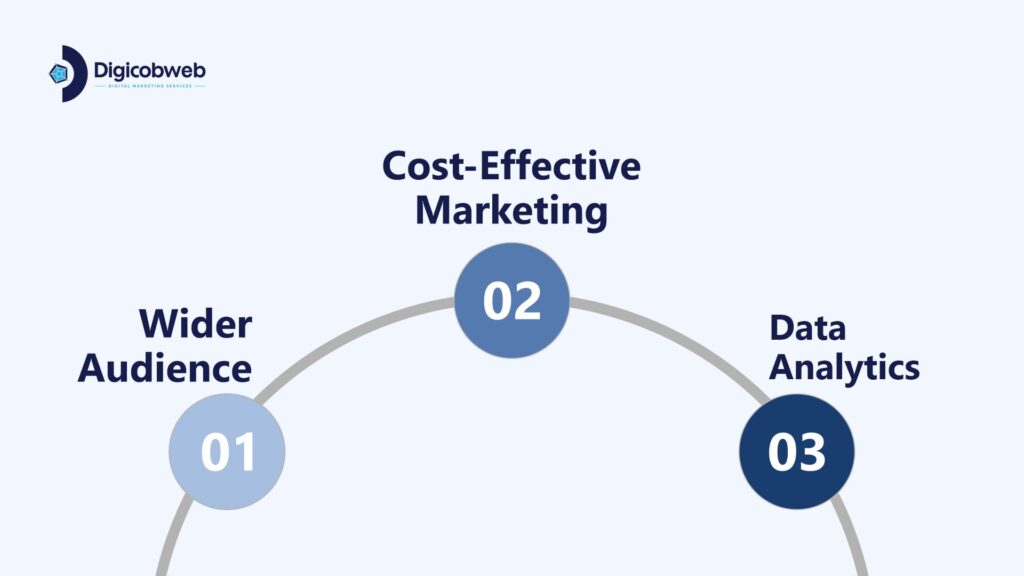
Benefits of promoting jewelry

  • Wider Audience: Digital marketing does not have regional restrictions so you can display your jewelry to buyers anywhere in the world. Expanding the coverage increases brand awareness, targets multiple customers, and opens opportunities for international markets.
  • Cost-Effective Marketing: Digital marketing is relatively cheaper than conventional forms of advertising. The cost for the PPC and social media ads can also be controlled depending on the amount the business wishes to spend. 
  • Data Analytics: Digital marketing can be used to get real-time results immediately after launching an advertisement or a marketing campaign. The use of such data enables better decision-making strategy development.

What Exactly is Paid Advertising?

Paid advertising helps ensure targeted visibility and customer engagement with investment in the promotions of products on platforms like social media and search engines. It has the advantage of creating awareness, and digital traffic, and drive sales opportunities since the advertisement is focused on targeted customers. 

The potential influence can be measured and tracked in real-time. Therefore, intelligent campaigns can enhance effectiveness in terms of ROI. Nonetheless, adequately conducted, paid advertising can significantly increase a brand’s market visibility and competitiveness.

Diverse Types of Paid Advertisements For jewelers

Different jewelry advertisements examples highlight the beauty of exquisite jewelry pieces. For advertising, jewelry retailers can use paid jewelry ads on search engines. The platforms include Google and paid social ads covering Facebook and Instagram. 

They can use targeted stories, visuals, and enable display advertisements on websites related to jewelry products for creating awareness. 

With the help of these below-concentrated jewelry advertisements examples and types, jewelers can easily attract wide yet niche customers.

Search Advertisements for jewelers and jewelry Showrooms

A valuable strategy for promoting jewelry business and drawing in prospective clients actively looking for jewelry products is to use search adverts. These sponsored links rise to the top of search engine results pages, attracting relevant traffic and boosting conversion rates. 

  • High Intent Targeting: Customers looking for jewelry-related keywords are drawn to search advertisements. This high-intent targeting makes the advertising more effective. 
  • Increased Visibility: Search advertising greatly enhances brand awareness by placing prominently at the top of many search engines. Apart from garnering more clicks, it also ensures that potential clients have more visibility to the brand.
  • Cost Efficiency: Pay-per-click search advertising allows you to be charged only when the message gets clicked by a user. With this approach, you may manage your money better to ensure that you obtain the maximum returns.
  1. Display Advertisements for Jewelry Owners

Display ads are those commercials that are in the form of visuals and are placed on websites, applications, and social interfaces. They utilise images, videos, and graphics to attract awareness and market jewelry brands. The relevance of these ads is to drive more specific online traffic to your website and increase your brand’s visibility.

  • Aesthetic Appeal: jewelry pieces’ beauty and artistry are exhibited through display commercials that use top-notch photos and videos. This visual appeal draws Potential clients in, which enhances their curiosity about what you offer and makes them want to buy. 
  • Targeted Placement: The websites and platforms that your target audience frequently visits can have display adverts put there wisely. In addition to optimising your advertising investment, this guarantees that the appropriate audiences see your adverts. 
  • Brand Awareness: Brand recognition is developed and strengthened by consistent display advertising. Recurrent exposure keeps your jewelry brand at the forefront of prospective buyers’ minds, increasing the likelihood of repeat business and cultivating devoted customers.
  1. Advertisements on YouTube for the Jewelry Business

jewelry companies can promote their products on YouTube by creating engaging videos that draw in visitors and convey a visual tale. By providing broad reach, accurate targeting, and quantifiable outcomes, this platform is a powerful instrument for raising brand recognition and encouraging consumer interaction. 

YouTube Ads for the Jewelry

  • Engaging Visual Content: jewelers can produce captivating, excellent images that highlight the brilliance and artistry of their jewels, thanks to YouTube’s video platform. More engagement and recall are achieved with this style than with static graphics since it better holds the viewer’s attention. 
  • Broad Reach: jewelers have the chance to reach a worldwide audience because of YouTube’s large user base. With this platform’s help, companies can attract new client bases from various locations and raise awareness of the brand.
  • Precise Targeting: Considering audience interests, age, and watch time, jewelers can target their audiences across the YouTube platform. Thus, higher conversion rates are combined with precise targeting, ensuring only interested spectators will view the commercials.
  1. Sponsored Promos and PPC Advertisements for jewelers

On social media, sponsored promotions present things to followers in an organic way. By charging per-click, pay-per-click (PPC) ads on platforms such as Google Ads guarantee visibility by optimising ad expenditure for measurable return on investment and targeted reach.

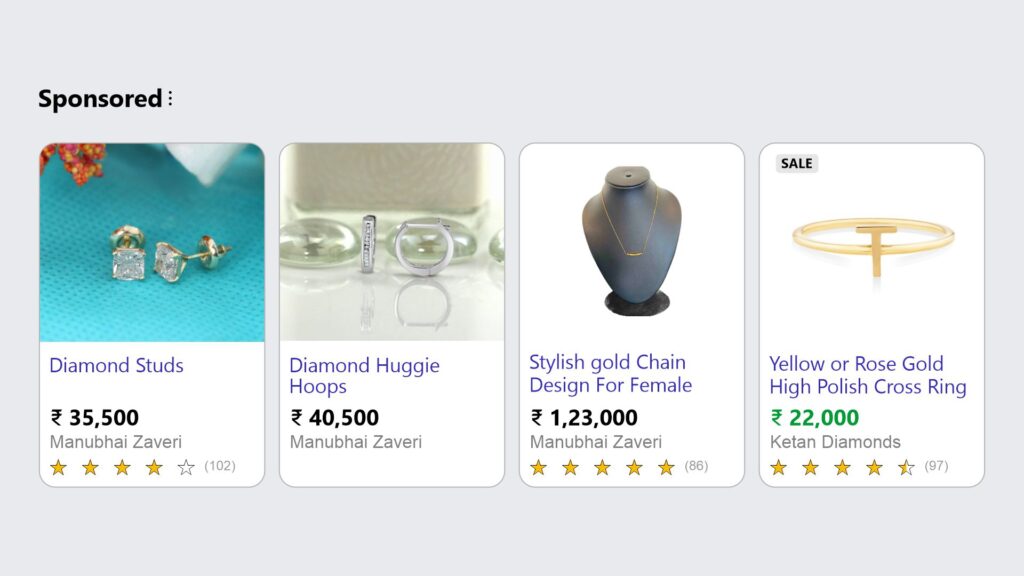
Sponsored Ads for jewelers

  • Social Media Sponsored Promos: These advertisements direct product placement in consumers’ feeds according to their interests and actions, utilising jewelers’ social media presence to reach a larger audience. 
  • Google Ads and PPC Campaigns: By targeting jewelry-related keywords, PPC ads, which are placed at a prominent position in search engines, grab the attention of people likely to buy jewelry products or seek information on them. 
  • Measurable ROI: Sophisticated analysis tools help jewelers measure and manage click-through and conversion rates, leading to a direct ROI.
  1. Evaluations of the Advertising Copy Used by jewelry Businesses

The advertisement copy of ornaments is reviewed for perceptiveness, attractiveness, and compliance with branding. Excellent copy should be oriented toward the target audience, stress USPs, and trigger an emotional response in the reader. 

  • Clarity and Messaging: Brief and concise writing ensures that potential buyers are concisely presented with the value proposition and quality of the jewelry.
  • Brand Consistency: The best jewelry ads showcase faithfulness and trust to the jewelry brand’s values, voice, and image. As a result, brand identification is reinforced, and customer trust is increased across all advertising platforms. 
  • Emotional Appeal: Effective Advertising jewelry examples utilise emotional appeal to evoke desires like aspiration and exclusivity, resonating with customers’ values and lifestyles. 

Tips and Best Practices for Jewelry Advertising

For promoting jewelry business and increasing your revenue, use the best jewelry ads and technique to grab your audience’s attention and generate sales. Here are a few tips:

  • Visual Appeal: Use images and videos to display your jewelry’s designs, brand identity, and quality. 
  • Targeted Messaging: Advertise your jewelry in such a way that it targets specific audiences and occasions where the jewelry will improve the look and the feel. 
  • Storytelling: Describe the source of ideas for each artwork to establish an emotional bond with the audience and stand out in the market filled with similar products. 
  • Call to Action: Get the customers to act immediately and ensure that the call to action is evident, for example, ‘visit our website,’ ‘shop online,’ or ‘come to our store.’

To craft the best jewelry ads, alter the current jewelry advertising and make it more alluring to help capture the view of customers.

Key Takeaways

In today’s cutthroat industry, jewelers have a vital tool in paid jewelry advertising to enhance brand visibility and attract targeted audiences. Along with taking inspiration from advertising jewelry examples, one also requires robust digital strategies. 

jewelers can strategically present their distinctive designs and craftsmanship to the global clientele. A measurable return on investment and effective budget allocation is guaranteed when targeted demographics are combined with real-time data for campaign optimization. 

These jewelry advertisements examples can help showcase the artistry and allure of fine accessories. jewelers can build stronger customer relationships and increase engagement and sales by highlighting their products’ unique qualities, genuineness, and intrinsic worth in their advertising content.

If you want to try paid ads for your jewelry business or are having challenges with managing your paid ads, we are here to help you. We will design a powerful Paid Ads strategy and help you in marketing your business. In the past, we have delivered great results to our clients who were in the jewelry business with the assistance of our digital marketing strategies, which assisted them to craft opportunities to gain more leads and prospects.

How To Perform an SEO Website Audit In 2024?

INTRODUCTION:

According to the digital 2023 data report by Steefy How Many Websites Are There in the World? (2023) – Siteefy

There are more than 692.0 million internet users in India, whereas 5,16 billion internet users are there worldwide.

To that there are 1.13 billion websites in the world.  

The surprising fact is that 82% of these websites are deactivated. The remaining 18% which makes 200 million are active.

Now let’s talk about trends, as we are aware small businesses are booming in India, according to GoDaddy’s Small Business Data Observatory 2023 – Business Results for India – Blog

In the last five years, 55% of new small businesses have launched in India. 

For these small businesses, the main source of sales and to reach customers in all parts of India is through e-commerce websites and shopping apps. 66% of small businesses have their websites.

This makes having a responsive website a survival point for businesses. That makes website audit an important factor to keep this site running without stumbling.  

One for making new customers, and two for supporting the current ones.

Your website must appear on search engines when someone searches for your business on the internet. How well does your website rank among your competitors?   

Is your website responsive enough? 

Other things like, Does your website work well on mobile or desktops? 

Does your website have content that adds value to your site? 

Do all internal links work on your site? 

When small things like this don’t work well on your site, the search engine would drive traffic to other websites instead of yours. 

If your website takes too much time to load or doesn’t have a call to action at relevant places, a customer might jump to another site.  

To prevent and repair all these situations website audit plays an important role. 

This blog takes you through some effective and proven steps to perform an audit report of your website.

What is a Website Audit? 

So that it can have an improved user experience.

An SEO website audit is conducted to analyze how well your website ranks on search engines. 

To check if your website has covered all the aspects that search bots analyze to rank your site on SERPs 

This makes website audit an essential factor in the online presence of a business. Carrying out an SEO audit of the website helps online visibility, improves overall ranking and customer experience, and makes purchasing easier and more convenient. 

One should consider viewing competitors’ websites to see if there are any blind spots they are missing.  Make sure that your website is more attractive and easy to use. 

You must frequently do a website audit to keep track of the performance of your website. 

It might be a case that your website does not have any gaps or errors, you still need to conduct a website audit to make sure everything works well on your site, just like it is supposed to. 

On the other hand, if you find errors you can fix them as soon as possible.

What is The Purpose Of a Website Audit And Analysis? 

Before we go into detail about how to conduct the website audit, let’s first learn why a website audit is important and required for your website. 

As the business world has gone digitally, the proper functioning of your business website has become a crucial part of its online presence and rate of online visibility. 

Businesses must ensure that their website works smoothly for their visitors, to take them where they want to, and to have better engagement. 

To ensure that every visitor is a retained customer. This is the shortest way to rank on SERPs. 

But that’s not it, there are plenty of aspects that a business needs to take under its wings before it takes flight. 

This flight is made easier by website audit, 

The website audit and analysis will help you filter out all the bugs that hinder your progress on Google search as well in terms of the user experience of your website. To help you gain your online traffic goals and give you an idea of how and what precautions and actions are needed to be taken to achieve them.  

To further look for how your site needs to be optimized and identify the tiniest issues that need fixing.

The core benefits of Audit are: 

Helps in identifying the strengths and weaknesses of your website

An SEO website audit helps you find blind spots on your website. 

What aspects of your website work well and what aspects do not work or need to be included? 

You should do a competitor analysis for your website to find what website essential aspects they are focusing on. And identify how your website is on the better or worse side of the internet. 

Identifying these issues will give your website a new outlook which will not only improve your ranking on Google but also boost the user experience of your customers. 

Areas of improvement for website audit

Once you identify the gaps in your website you can work on improving those aspects that will directly affect the performance of your website. 

If you carry out website audit regularly you can identify major key performance factors and keep your website updated. 

It does not only help you to work on your weaknesses, you can work more on your strengths making them the major performance factor of your website. 

Online Visibility/Rankings on the Internet

SEO audit is essential for improving search engine visibility. To keep your website up to date you need to perform a website audit from time to time to keep up with the latest changes that Google keeps introducing.   

For example, for whatever content is present on your website, the search engine considers E-E-A-T.  (E-Experience E-Expertise A-Authoritativeness T-Trustworthiness)

This provides search engines with credibility and relevancy license of website content which is one of the important aspects of any website.  

Search engines also take into account the overall working of your website. The design, content, and technical aspects.  

Is your website regularly updated with upcoming changes?

Is it being managed and optimized regularly?  

This all contributes to the overall ranking and visibility of your site. 

Determine selling goals 

A good website knows what its users are searching for, what they need the most, and how to make it easily visible. This is why we do website audits. To know what your customer requires most and how to provide them with easy accessibility.  

A good website that has a call to action at the right places. 

Blogs that educate customers about products and services. 

A well-written case study of customers and clients that has been part of business and their feedback.

A clear statement of mission vision and values  

All these things add value not just to the website but to the business entity as well. 

Everything that a business does has an end goal of making their customer satisfied, making a better website is also for the same. 

Better user experience will eventually lead to increased sales.  

How to do a website audit?

You can get your website audit done in several ways. There are multiple tools available online both free and paid. 

Some of the most efficient tools for website audit are: 

 Google Search Console

Semrush Free technical SEO audit with Semrush SEO analysis tools

Hubspot HubSpot | Free SEO Tools

An even better option is to hire an SEO expert to audit your website and do regular optimization.  

If you are doing it by yourself  consider going through the steps given below; 

1. Check for the URLs

Before starting with the website audit, gather essential information related to your site’s domain. Such as; 

  • How is your website URL & is your website Secure?

URLs

URLs are important to find pages of your site on the internet. They are one of the ranking factors as they not only help viewers but also help search bots understand what your page is about. 

 There are a few things you need to keep in mind while forming URLs,  

URLs need to have keywords that describe the exact content of the page and thus do not mislead the server. They should be short and exact and describe the page content. Use a hyphen to separate words. You should make a standard URL naming process. 

Security

Security is a major factor when it comes to websites. They are vulnerable to multiple security risks.

Hacking cases are increasing day by day, and thus to prevent that google has come up with many security regulations. 

Security plays a major role in SEO. If a website is hacked, google as well as other servers would flag it to keep visitors safe and away from it, which would risk leakage of their data. This will automatically lower your website’s rank in SERPs, and your website traffic will be driven to other websites and thus prevent conversions.

In 2017 google came up with another security measure that if any website uses basic HTTP will be marked as unsecured on Chrome web browser.  

This will help visitors stay away from such sites. As a website owner, it is necessary to be updated about all such updates. 

These are the two things to check before diving into a website audit. 

This is a way to know how good your website is doing from a Google crawler perspective. 

On-Page SEO audit of the website 

Check following this while doing On-page SEO, these features play a major role while Google crawls your website to rank them on SERPs  

Title tags: 

  • Check if all your pages have different title tags, duplication confuses bots and your page might end up getting unnoticed 
  • Make sure your title tags call for action which increases CTAs 
  • Your title tags should be under a limit of 50-60

Meta Description: 

  • The meta description should be a precise description of what is the blog about, making sure it answers the most searches on search engines which will in turn help increase CTAs 
  • The meta description works elevators pitch for your content, so make it as convincing as possible for viewers to click through
  • Your meta description should not exceed 160 characters 

Heading tags: 

  • There should not be multiple <h1> tags on the page, 

the remaining headings are supposed to be <h2> tags 

  • There should be a clear hierarchy structure of heading tags that will help crawlers classify content  

Alt tag: 

  • Your alt tags should be relevant to the context of the image. 
  • Your image may take too long to load if it exceeds 100kb. So make sure they are under this limit
  •  Your alt tags should not exceed 125 characters

Url optimization:  

  • Use exact keywords to form the URL. Take out unnecessary extra words 
  • Make sure it is short and simple
  • There are other things in the format of URLs like you should not use capital etc

Content gap analysis :

You can do a competitor analysis to find what more content you can add to your site, such aspects can be followed,

  • You can add internal links to blogs and services pages if they are missing
  • Service Pages can be improved by adding some content and sections like Reviews, Work, etc
  • Navigation 

Make sure your website is mobile-friendly as most of the population is smartphone users.

A clear navigation bar, custom 404 page, sidebar, and avoiding clutter in the menu, etc make a smooth navigation website.

Visitors might jump to other websites if they are not able to navigate easily on your  website, 

You can use the free tool Ahrefs WordPress for content audit, monitor backlinks, and grow organic traffic. 

Technical SEO 

Page speed: 

No one will ever stay on a page that takes too long to load. Page speed has always remained a ranking factor. 

Also, remember that loading speeds on mobile and desktop are different. Speed on mobile is more important because 91% of traffic comes from mobile users. https://www.woorank.com/en/blog/tips-and-tools-for-creating-mobile-websites

You can check your page’s speed on-site audit as well as page speed.  A tool that helps you analyze a website’s speed. 

Sitemap issues 

Indexing:  

Google can’t rank your website if you have not indexed your pages. 

Index only those pages that you want Google to rank. All pages on your website do not need indexing. And it is completely okay to not have all pages indexed. Amid pages, feed pages, etc need no indexing. Blog pages, home pages, services pages, etc are important to be indexed. 

Issues with indexing should be fixed; 

Redirect issues that do not take users to the desired page and lead them to a random page. 

There can be issues with HTTPS, like slow loading, broken links, and error messages. To read more about this check out the Page Indexing report – Search Console Help

Robots.txt: 

Robot text is a very important factor as it is a security factor. It helps certain pages private which you don’t want outsiders to view. 

It needs to be in a structured format. 

Add rules to your robot.txt file, add it to the root of your site, etc. 

You can use the Google Webmaster  ​robots.txt report – Search Console Help

check your Robot.txt

Structured data markup: 

Also known as schema markup: 

Here are some of the important schema that should be added to your site, 

Website, FAQs, Service, Person (For Blogs & News), Logo, Aggregate Rating, Review snippet, ItemList, VideoObject, Local Business, etc 

This Google tool will help you create and correct structured data markup for you 

Schema Markup Testing Tool | Google Search Central

Open Graph and Twitter tags: 

The following things are crucial to include; 

Og title: This will be visible whenever someone links your website. So create it in such a way it draws attention but also short and uncomplicated. 

Og name:  Remember that this differs from the actual title of your webpage and is usually shown under the title itself.

 Og: description – it’s a brief description of your website. This should be no more than 2 or a few lines. 

 Og: type – This is a tag to determine the type of content

 Og: image – URL for an image that you want to display. The minimum size is 50 by 50 pixels and must be in JPEG, GIF, or PNG formats.

Og: URL – The URL that you want your content to link to.

Monitor the ranking of your site 

The best way to track the effect of all medicines you take to repair your site. This is the best way to track the ranking of your site. 

 It helps to track; 

  • How the traffic has been improved from before
  • How it has shown an effect on SERPs in different geographical locations 
  • Compare the rankings of your site with your competitors 

Keep a close eye on manual Google updates: 

As Google keeps on giving new updates regularly websites must be in sync with it. So that it does not lag behind SERPs.

Conclusion: 

The website is a great start for a business website for its success.  

Remember that this process is a constant and never-ending process to keep your site updated. 
So go digital. And be updated.     

Google update of 2021

2021 in history was considered an important year for the major changes Google brought in its algorithm that completely changed the game. It improved user experience to a great expanse.  

1. Page Experience Updates For Desktop

The update was announced on November 4, 2021, but rolled out in 2022 on February 22 and ended on 3 March. 

First, we are all familiar with mobile-friendly page experience, now page experience for desktops is quite similar to all the parameters except that of mobile-friendliness. 

That means that your desktop screen is measured in the same way as your mobile screen experience. 

Largest contentful paint (LPC): Scale for the measurement of perceived load speed and landmarks when the page’s main content has loaded. 

Cumulative layout shift (CLS): measures visual stability and layout shift that affects user experience. 

First input delay (FID): the response time that the user first took to interact with the page. 

HTTPS security: a protocol that protects data shared by users with the site page. 

Absence of intrusive interstitials: the popups on the page screen distract users from viewing the actual content. 

The update made core web vitals a desktop ranking factor. Above are some of the factors that affect desktop ranking. 

Before this update Google Search Console report allowed sites to review their desktop core web vitals.  

(what is a Google search console is a free service offered by Google that helps you monitor and troubleshoot your website performance on search engines)

2. Product Review Update:

December product review update

Rolled out on 1 December and lasted till 21 December 

Like any other product review updates were aimed at rewarding high-quality honest reviews rather than overloaded with marketing and selling perspective reviews or rather less informative reviews. Because Google believes  that karma is the guy on the screen and also on the rankings in SERPs 

The volatility was highly affected by this update. This update was quite long and took around three weeks to roll out. 

With this update, there were two extra guidelines Google added to its PRU rulebook 

  • To add evidence of personal experience with the product and services
  • To provide links to multiple sellers from which users can directly buy the product or services if convinced.

This guideline unfortunately or fortunately was not implicated directly as sites did not add links and proofs did not lose their rankings. As the guidelines were Google is planning the landing of these better quality product reviews and not where how currently algorithms perform. 

April product review update. 

Here is the change of volatility in SERPs during the update.

April product review update: 

The first-ever product review was released in April of 2021 on 8 it was completed by 22. 

The idea behind this was to reward expert reviews rather than just content that describes a bunch of products. With this google educated webmasters and experts and how it was going to work, with its guidelines. 

What should be included in the product review according to the guidelines of the google?

  • To provide users with knowledgeable analysis and research of the product
  • To upload authentic content written by field experts and enthusiasts 
  • To provide competitor analysis of the product 
  • To provide with Pros and Cons of the product 
  • To inform about key decision-making factors
  • To provide the new features and how the product has evolved

3. Core Update: 

What are core updates?

Google uses core updates as a means of rewarding websites that ethically obey their spam and algorithm but still don’t rank well on search engine results pages.

 However, the updates do not expressly target harm to pages and websites that violate the guidelines. 

The primary update’s modifications include a review of the material as a whole and a ranking of the less-rewarded websites. 

Why does Google release so many core updates? 

to provide credit to pages that have not been ranked even if they offer excellent added value, a wealth of experience, and user-friendly content. 

to stop duplicate and non-authoritative information from appearing in search engine results. 

to put an end to those who try to undermine Google’s goal of giving its users the most relevant information possible. via questionable SEO techniques. 

Core improvements aim to bring to the fore credibility, know-how, and authenticity that Google and its users can rely on. 

Core update November:

The update hit the health industry the most; all other industries were affected all over, and the volatility spiked to a peak. For the initial two days, the volatility stayed at its peak, and then again normalcy was declared, like always. 

Desktop SERPs peaked by 12% volatility 

Mobile SERPs peaked by 23% volatility 

Average volatility peaked at 20% in comparison to the July core update. 

Google Algorithm Update History [+ Latest SEO Changes]

July core update: 

Was announced on 2 June, started to roll out on July 1st, and ended on 12 July. 

This core update was to be part of the June core update, but as it was the first ever Google introduced the core update. They left a part of it for the June update for July. 

The core update brought changes that were hardly noticeable by most sites and pages. 

June core update: 

The first-ever core update of the year was released on 2 June and ended on 12 June. 

Google had high expectations with the core update but they could not implement all the updates planned and thus the second part of this update was left out for July

Google had admitted “Some of our planned improvements for the June 2021 update aren’t quite ready, so we’re moving ahead with the parts that are, then we will follow with the rest with the July 2021 update. Most sites won’t notice either of these updates, as is typical with any core updates.”

Many sites saw a spike in their SERP volatility, while many had negative impacts. 

It was advised to perform a site audit and correct what was wrong before the site got hit by the other core update of July. 

4. Spam Update: 

What is a Spam Update?

Google quoted “Google’s automated systems to detect search spam are constantly running, we occasionally make notable improvements to how they work. When we do, we refer to this as a spam update and share when they happen on our list of Google Search ranking updates.”

Spam update of November: 

Was released on 3 November 2021 and completed on 11 November.   

With this update, Google had advised websites to focus on SEO best practices. The update focused on improving Google’s ability to update its spam detection techniques. 

There had already been three previous spam updates which makes searches spam-free.

In the previous year, google had blocked 25 billion spammy pages from being indexed by search engine algorithms. 

Websites that follow the webmaster guidelines ethically and do not mess with Google algorithms and deceive it for the sake of ranking do not need to fear Google spam updates.

June spam update (part 1)  

Started on June 23  the update was completed within 24 hours 

Same as any other spam update, this Google spam update was focused on fighting web spam. Multiple spam updates occur many times a year which indicates that Google wants the web to be completely safe for its users and top every black hat SEO practices, which is unsafe for its users.  

June spam update (part 2)

Started on June 28 and just like the previous update was completed within 24 hours. 

Part two of the previous spam update rolled out after 8 days, while the purpose remained the same for both updates. The second update was a step closer to enhancing the spam detenting Google algorithm  

5. Link Spam Update

Link spam update rolled out on 26 July 2021 

Was focused on nullifying spam links on websites across many languages. 

The update targeted guests, sponsored and affiliate content

Google has guidelines for using each of these links: 

Affiliate: google asks sites participating in affiliate programs to qualify links with 

rel-” sponsored”. Irrespective of links being created manually dynamically. 

Links sponsored posts: links that are paid advertisements or paid placements should be marked up with rel-sponsored value. 

Targets guests: links of guests should be marked up with rel-”nofollow” value.  

6. Page Experience Update For Mobile:

Is to make the user experience of the mobile users better. The mobile ranking is affected by the following factors 

Largest connect paint (LCP): the time taken for the main content page to appear 

First input delay (FID): the response site or page takes to respond to the user 

Cumulative layout shift (CLS): the measure of layout movements during the loading of the page. 

The following steps will be taken by Google for this algorithm change 

  • Include a report on Page Experience in the Search Console.
  • Eliminate the AMP requirement for Google Search’s Top Stories carousel.
  • Take down the AMP badge image.
  • Allow signed exchanges (SXG) while searching on Google

2022 Google algorithm updates

2022 in history was considered an important year for the major changes Google brought in its algorithm that completely changed the game. It improved user experience to a great expanse.  

1. Link Spam Update: 

 It was released on December 14, 2022

Google uses an AI-based prevention system called Spam Brain to detect spam all over the internet. This update was to detect unnatural links in the search results.   

With these updates, google tried to end buying and selling links to manipulate rankings on search engines. Buying and selling of links that affect PageRank violates Google webmaster’s guidelines. 

The update will work on neutralizing spammy links till all the credits passed by unnatural links are lost. This means that the site that gains rankings through this backlink will lose its traffic. 

These links were acting like parasites of the ranking webpage and feeding on their traffic. This update aimed to remove these practices.

2. Helpful Content Update 2022 

Helpful content update for December 

Announced on 6 December continued into January until 12. 

A helpful content update is for: 

Better rewarding material that engaged users and improved their user experience was the main goal of the change. 

A lot of websites include valuable material that does not rank well in search engine results pages, therefore these improvements concentrate on taking action against that content. 

Google feels it is essential to give helpful and original content to the users. This update aims to uplift “how people look for information and the diversity of quality information that exists in the world.” 

E-A-T which meant expertise, authoritativeness, and trustworthiness was updated to E-E-A-T. The other E serves for experience. It is easier to learn from and trust someone who has experience in the subject rather than just knowledge about it. Especially around a few technical subjects. 

This update tries to put an end to content solely written for SEO purposes and gain rankings when it should be about imparting experience and knowledge about the topic at hand.   

The first ever helpful content update was released in August

Let’s not let it slip like a bottle of wine.  

Announced on 18 August 2022, started to roll out on 25, and ended on September 9.

Google wanted to make sure that the content available on the SERPs is not for search bots to rank but for people who want to learn. 

Thus came helpful content updates “That’s part of a broader effort to ensure people see more original, helpful content written by people, for people, in search results.” 

Google also gave guidelines that you can follow to make sure that the content you create is helpful for people

Below are the questions given by Google that you can ask yourselves while you create content for your audience. 

  • Do you have an existing or intended audience for your business or site that would find the content useful if they came directly to you?
  • Does your content demonstrate first-hand expertise and a depth of knowledge (for example, expertise that comes from having used a product or service, or visiting a place)?
  • Does your site have a primary purpose or focus?
  • After reading your content, will someone leave feeling they’ve learned enough about a topic to help achieve their goal?
  • Will someone reading your content leave feeling like they’ve had a satisfying experience?
  • Are you keeping in mind our guidance for core updates and product reviews?

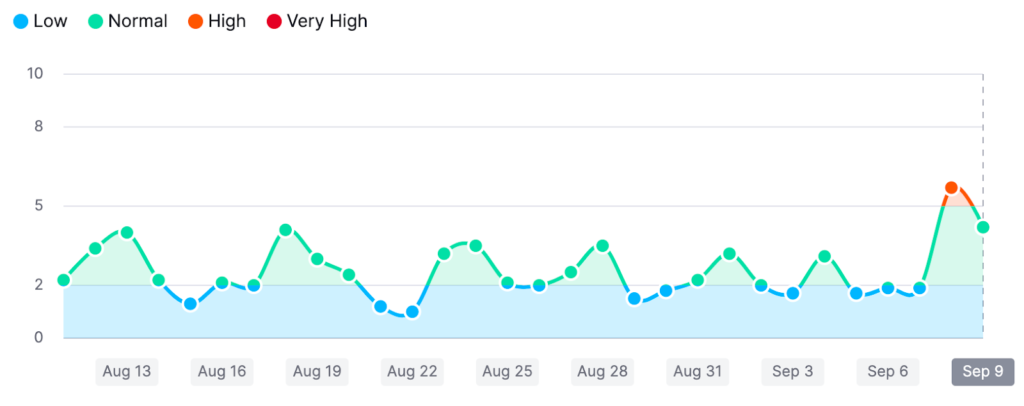
We dig out some data for you from Semrush at a point of time near the 7 and 8 of September 2022, the volatility spike was quite significant on these days.  

high volatility in the SERPs on September 9

3. Product Review Update 

Started 20 September and completed by 26 September 2022

Product review updates are designed to rank reviews that are in-depth and advising about a particular product, or service. 

The update also focuses on demoting the ranking of those product reviews that are low-quality and lack real experience of the product. 

These updates are usually 2 weeks long but the one in September ended within six days as there were previously two product review updates in the past. 

This update will only impact the website pages that have product reviews, and if you still notice changes it might be because of the the core update. 

As in earlier months google associated ranking factors with helpful content there was a slight alignment of it with the review update which is also again meant to help users.

The previous product review update came in July

Started to reel on 27 July and ended on August 2, 2022

It was the fourth in a series of algorithm updates that focused on rewarding high-quality product reviews. And give them a rightful ranking for good and helpful reviews. 

The following update was considered less volatile than the March product review update.

The reason why Google had another product review update in September which was able to impact websites that failed to get impacted by the July update.

March product review update

Rolled out on 23 March and released on  6 April. 

The update focused on identifying high-quality product reviews, to do it like a pro and like never before.   

The update had a slow start when it was first released but had high volatility towards the end of the month. 

Google had added a couple of advice on what matters most in the review update. 

  • Include helpful in-depth details, like the benefits or drawbacks of a certain item, specifics on how a product performs, or how the product differs from previous versions
  • Come from people who have used the products, and show what the product is physically like or how it’s used
  • Include unique information beyond what the manufacturer provides — like visuals, audio, or links to other content detailing the reviewer’s experience
  • Cover comparable products, or explain what sets a product apart from its competitors

How can you recover from the impacts of the update? 

You can refer to Google guidelines in this link.  

How To Write Reviews | Google Search Central | Documentation

4. Core Update 

The most important updates as they impact the searches overall. Google releases core updates several times a year to keep up with the changing tendencies of the web. At the same time, the core update does not target anything specific to the websites. However, they make some notable changes that are crucial for SERPs and decide how sites perform and influx the website traffic. 

Google’s search algorithm is continuously changing, but these changes are minor and do not make notable changes, while Google’s core update brings about changes that are quite noticeable and impact certain websites. 

September core update 

Reeled out on 12 September and completed on September 26

The core update on hand overlapped with helpful content updates and was assumed to bring a lot of major changes. But it failed to do so. 

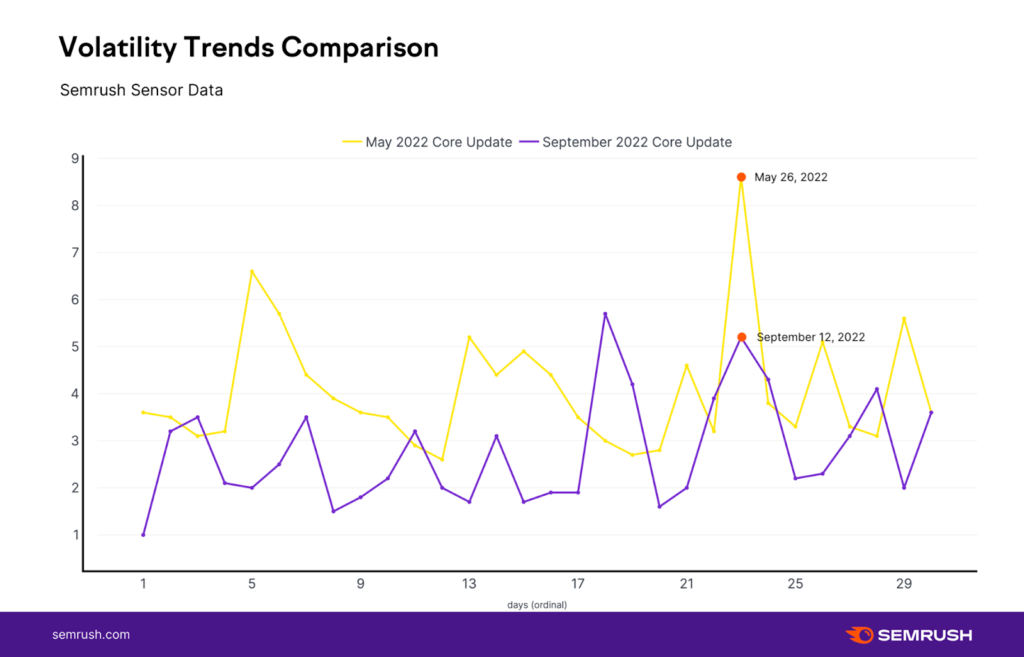
The volatility of the search engine was 6 on 10. 

You can take a look at the chart below which is to comparison with a core update of the previous month’s core update. 

May core update 

These updates came out on May 26 and were completed on June 9, 2022 

The update was considered quite impactful as many users experienced fluctuation in their traffic on the website.

The update impacted hurt AI-generated content and had a positive impact on human-generated content. 

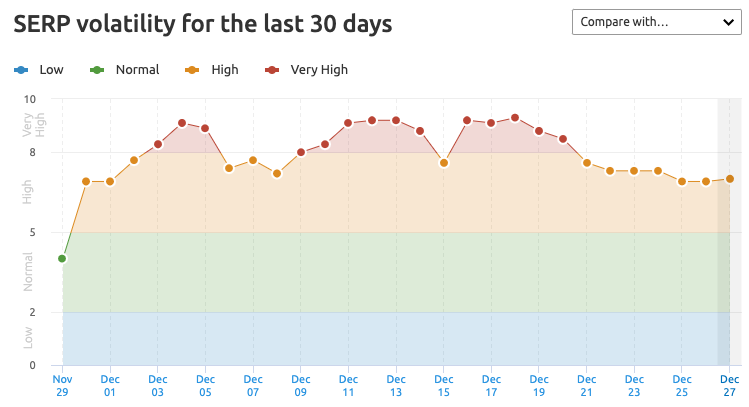
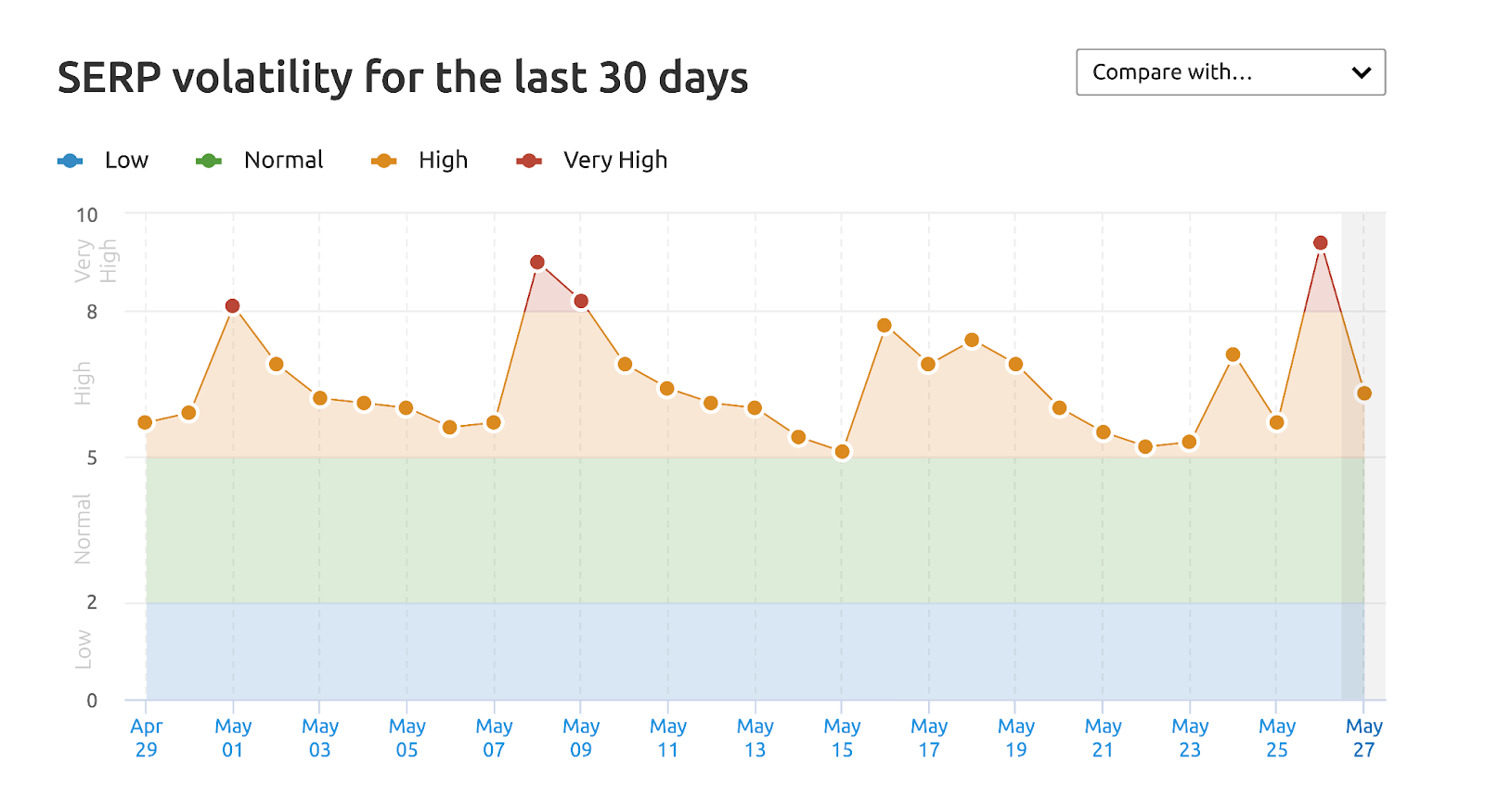
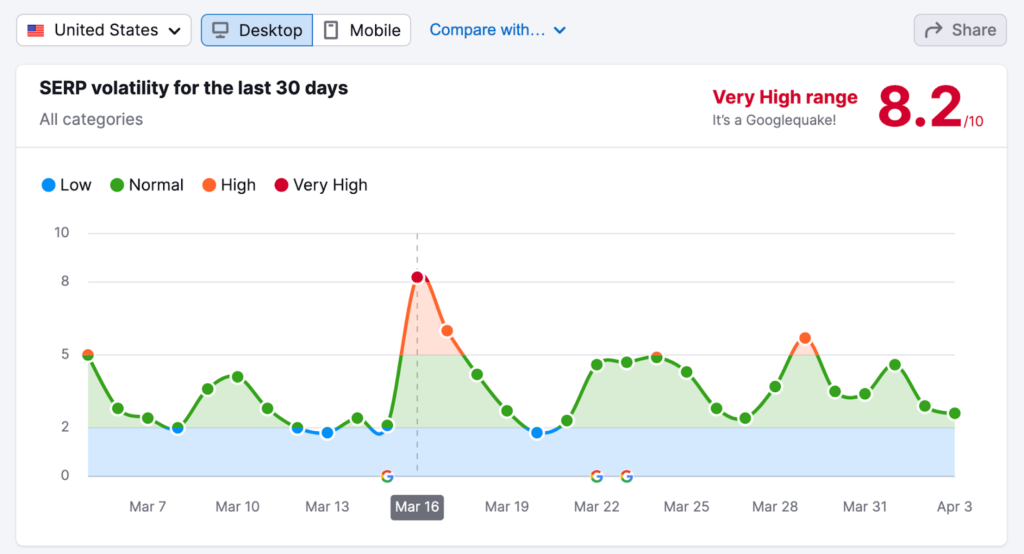
You can see on the Semrush chart, observe the changing volatility throughout the 30 days.

SERP volatility for the last 30 days chart

This was all for 2022 algorithm updates. To read more in detail about these updates refer to blogs on Google that talk in great length and also suggest great ways of how to recover from the negative impacts of these updates. 

Google Algorithm Updates of 2023

1. Google Review Update

Review update of November  

The update was out on November 8, 2023. It was designed to reward high-quality authentic review content on webpages focusing on review articles, blogs, FAQs, and other content providing analysis, recommendations, and opinions posted on Google authored by experts and enthusiasts, influencers. 

Your content should be centered around three major things, 

  • To impart knowledge and showcase expertise 
  • Give evidence of data presented 
  • To showcase the advantages and disadvantages of a subject that is written and is being discussed. 

The aim is to empower users by providing them with authentic information, and content that does not deceive customers and help them make the right decision.  

Review update of April

Another review update was released on April 12, 2023, this google update focused on in-depth feedback, and reviews rather than peppery thin content that does not provide much insight.  It included games, destinations, products, movies, and more reviews. It lasted 13 days. Ending on April 25, 2023. 

Product review update of February

This update had a major impact on SERP volatility, which peaked very high on March 1, 2023 

Google recommended;   

  • To provide proof of your experience with the product or service. 
  • To Include links to multiple sellers. 

2. Broad Core Updates And Core Updates

What are core updates? 

Core updates are nothing but Google’s way to reward the sites that follow their spam and algorithm ethically but still fail to rank on SERPs. On the other side, the update does not specifically target harm to the sites and pages that do not follow the rule book. 

The changes that the core update brings about are to examine the overall content and rank the under-rewarded sites. 

Why does Google release so many core updates? 

  • To reward pages that have failed to rank despite having great expertise and knowledge, great added value, and content that is helpful to the users. 
  • To prevent nonauthoritative and duplicate content from ranking on SERPs. 
  • To stop those who manipulate with mission and vision of Google to provide the most relevant information to its users. By dubious SEO practices. 

Core updates try to surface authenticity, knowledge, and expertise that is trustworthy for Google and its users.

November broad core update 

It was out on November 2, 2023, and completed by 28 of November. It was aimed to provide relevant and dependable searches to the customers and provide them with valuable information. This could positively affect your website traffic if your website content is authentic and is what search bots search for on your website.

For this update, google also mentioned that pages that already follow and focus on people-centered content and practices google best practices can do little. “Chances are, there’s nothing to do for most creators who have already been working to create helpful, reliable, people-first content,”

“We have different systems that are considered core to our ranking process; this month’s core update involves an improvement to a different core system than last month,” Google had said “However, our guidance about core updates is the same for both.”

October broad core updates 

Rolled out on October 10, 2023, ended on 19 October, 2023 

It is directed towards search algorithms and systems.

As in core updates, Google sends out the list of changes it implemented in Google search ranking updates.

It focuses on providing dependable and trustworthy searches to its customers. 

To read more on the same you can read, Google Search’s Core Updates | Google Search Central | What’s new | Google for Developers

August core update

Started rolling out on August 22, and wound up on 7 September 2023. Aiming to improve search results. 

This update had a heavy effect on search volatility compared to the March core update. Just after 3 days of rolling out the volatility spiked to 9.3 according to the Semrush sensor while the March update reached a volatility of 8. The update also had effects on the ranking of URLs, promoting the pages that did not serve its efforts.  

Head of SEO at WIX and communication consultant at Semrush Mordy Oberstein said. “However, if you look at the increase in rank volatility as compared to the pre-update volatility then the March 2023 Core Update seems more significant. However, even there, as mentioned, more than a few verticals saw more dramatic volatility increases with the most recent update” 

March Core update 

Rolled out on 15, 2023 was focused on improving content quality online like all other core updates the update led to a spike in search engine research page SERPs from the very next day of its announcement. Higher volatility was seen in mobile rankings. 

3. Spam Update

What is a Spam Update? 

Google quoted “Google’s automated systems to detect search spam are constantly operating, we occasionally make notable improvements to how they work. When we do, we refer to this as a spam update and share when they happen on our list of Google Search ranking updates.”

Google released its spam update on 4 October 2023, it focused on plagiarized, misleading, and lack of originality and overly promotional rather than informative content. The spam update was wound up by October 20. 

The update of the effect of increased spam results especially in the native tongues of the users. 

Google uses AI and human reviewers to identify such content. 

Content such as: 

  • It has little added value and is not human-generated.
  • Hidden text and links that are only visible to search engines.
  • Too many ads or too many direct or indirect promotions.  
  • Doorway pages that confuse search engines and users.  
  • False claims etc. 

It is recommended that sites provide open doors, a see-through user experience, and true expertise. 

It is also advisable to do regular website audits after the release of an update. You can check for misleading, AI-generated, scrapped, and hidden content or excessive ads that take away focus from the main content or are overly promotional content that does not impart much knowledge but promotes the business.    

4. Helpful Content Update

What is a helpful content update?

The update focused on better rewarding content that satisfied users and also gave them a better user experience. 

These updates focused on taking action on content that was not helpful yet ranking on SERPs, while many websites have content that is helpful and yet failed to rank on SERPs. 

A tool that classifies this content is an automated tool. It works for all international languages. It is one among many signals Google uses for rankings. 

The update released on 3 September 2023 brought two major changes. While Google also answers, How can sites recover from the effects of an update? 

  1.  google loosed up its barricades on AI-generated content

The previous update of Google had a strict policy “by people for people” improvised to “helpful content generated for people” The barricade has loosened around the AI content guidance by Google. 

 Signaling Google’s change of perspective towards AI content.

  1. Helpful content update putting an end to third-party content hosted on subdomains or the main part of the website.  

The idea behind hosting third-party content on the main part or subdomain of the website is to rank with the use of the ranking power of the main website. 

Google’s 2023 helpful content update website affected websites negatively that used this tactic to rank. 

 Self-assessment guidance that will help websites recover from the impact of helpful content update 2023. 

The rule one and last that Google always implies constantly and talks very often is Creating; reliable, helpful, and people-first content. 

Following is the guidance given by Google 

  1. “Is this content written or reviewed by an expert or enthusiast who demonstrably knows the topic well?”
  2. “Are you changing the date of pages to make them seem fresh when the content has not substantially changed?”
  3. “Are you adding a lot of new content or removing a lot of older content primarily because you believe it will help your search rankings overall by somehow making your site seem “fresh?” (No, it won’t)”

Google Algorithm Updates and Their Benefits to Digital Marketing

As we know the digital world around us is ever-changing, every day you wake up to find something new on a digital platform that will make you change your strategy approach to reach your audience and customers online.  

To change your way and adapt to new updates.  And that’s a rule of survival, isn’t it? 

The only thing constant is change and as the businesses, shopping behavior, and customer needs online are constantly rising. Google understands and knows its users like no other and that is why Google runs more than  600,000 experiments each year ranging from Natural language processing to BERT, these efforts are directed towards making their user experience more enhanced. About the updates, daily search engines make an average of nine changes, and in a year alone 3200 changes are adopted by Google. 

In 2022 and 2023 alone, Google made more than 15 algorithm updates, which became difficult to track and implement. This blog will walk you through the latest Google algorithm updates as well as the history of Google algorithm updates that have made major impacts on the search engines that we use today.

Why keeping up with Google Algorithm Updates is important for Digital Marketers?

Google algorithm updates to deal with the optimization of online content and their rankings overall. Facebook, Instagram, and X are search engines in themselves. And understanding the Google algorithm updates and keeping up with them will help rank their content on all these platforms. 

Google Algorithm Updates and Pay-Per-Click

Google algorithm updates play a game-changing role in pay-per-click adverts. The more updated and informed you are about Google’s algorithm updates, the better chances you have to rank higher than your competitors. 

These paid adverts are based on higher ad visibility, ad positions, and cost per click which are impacted greatly by search engine algorithms.

Google Algorithm Updates and Social Media

As for social media marketing, as mentioned before, media such as Facebook, Instagram, and X are search engines in themselves. 

Comprehension of Google algorithm updates will help social media marketers optimize their media accounts for better reach and visibility. 

Google algorithm evaluates a business’s social media accounts just as it evaluates websites and pages of your business. Your social media accounts and content must be optimized regularly to attract organic traffic on your media accounts.

Google Algorithm Updates and Content Marketing

In the past year, Google has made maximum efforts to distill authentic and informative content from loads of copy and plagiarized content. As the use of AI has increased, there is less human-generated content that does not impart the knowledge and experience that most users are searching for. Many Google algorithm updates focus on content marketing which we will see further below. 

Being ahead of the curve with updates will help you plan your content strategy better. 

Helping you get better visibility and rankings. Some of the best content marketing strategies include optimizing your page speed, using proper main headings, and subheadings, using bullet points, and keeping white space, using attractive and relevant videos and images that align with the text. 

To read more on the importance of Google SEO algorithm updates you can visit Unveiling the Secrets of the Google Algorithm for Digital Marketer’s Success.

How do you know if your business is affected by Google Algorithm Updates: 

When a Google algorithm update hits the site the effect of it is usually seen in the traffic on your site.  A sudden drop in your traffic or sudden rise in traffic while rolling off the update. You can use Google Analytics to check your traffic regularly.  

How to recover from Google Algorithm Update if your site has been affected: 

If your ranking and traffic are affected by Google algorithm updates you check any Google guidelines. 

You can also conduct an audit of your website and competitor analysis that did well. 

Make your SEO strategy based on Google guidelines and best practices which will eventually lead to success. 

You can read about past year’s Google algorithm updates by clicking on the following links

Google Algorithm Updates of 2023

Google Algorithm Updates of 2022

Google Algorithm Updates of 2021 

As we talked about the world around us changes every day and Google rather changes we humans who make and run sites with content designs and a selling and marketing approach it will be difficult to track everything all at once. So remember one step at a time and you be notified of new updates as they come from the new year. 

And rest you can rely on us. We will keep you updated. 

Let’s be tuned together tuned for you!